

Bauhaus furniture: history, iconic pieces and how to furnish in Bauhaus style
A chair without back legs, an armchair made of steel tubes, a lamp of glass and metal: a hundred years ago they looked like laboratory experiments. Today they are in millions of homes, often without their owners knowing where they come from.
Bauhaus furniture is the furniture created between 1919 and 1933 at the German school founded by Walter Gropius: essential geometric shapes, industrial materials such as tubular steel and glass, no superfluous decoration. The most famous pieces are Marcel Breuer’s Wassily armchair and Cesca chair, the cantilever chairs by Mart Stam and Mies van der Rohe, the Barcelona chair and Wilhelm Wagenfeld’s lamp. Their legacy lives on in today’s cantilever chairs and modular systems.
At a glance
- The Bauhaus was a school of art, design and architecture active in Germany from 1919 to 1933, in Weimar, Dessau and Berlin.
- Key principles: function, industrial production, geometry, new materials.
- Iconic pieces: Wassily armchair (1925), Mart Stam’s cantilever chair (1926), Mies’ MR10 (1927), Cesca chair (1928), Barcelona chair (1929).
- Several famous names, such as Wassily and Cesca, were given in the 1960s by the Italian manufacturer Dino Gavina.
- Since 1996 the Weimar and Dessau sites have been a UNESCO World Heritage Site.
What was the Bauhaus?
The Bauhaus was born in Weimar in 1919, when the architect Walter Gropius merged the academy of fine arts and the school of applied arts into a single institution. The idea was simple and radical: artists, craftsmen and architects should work together to design objects that were beautiful, useful and suitable for mass production. In 1925 the school moved to Dessau, into a building designed by Gropius himself; in 1932 to Berlin, where it closed in 1933 under pressure from the Nazi regime. In fourteen years it had three directors: Gropius, Hannes Meyer and Ludwig Mies van der Rohe.
Its teachers and students included Wassily Kandinsky, Paul Klee, Josef Albers, Marcel Breuer, Marianne Brandt and Gunta Stölzl. Many of them emigrated after the closure and carried Bauhaus ideas to the United States and across Europe.
What are the most famous pieces of Bauhaus furniture?
Wassily armchair, Marcel Breuer (1925)
Breuer, a young master of the carpentry workshop, took inspiration from his bicycle handlebars and built an armchair of bent steel tube with seat, back and arms in canvas or leather straps. The name Wassily, a tribute to Kandinsky who owned one, came in the 1960s, when the Bologna-based manufacturer Dino Gavina put it back into production.
The cantilever chairs of Mart Stam and Mies van der Rohe (1926 and 1927)
The cantilever chair does without back legs: the seat floats thanks to a single continuous frame of steel tube. The first prototype was by the Dutch architect Mart Stam in 1926; the following year Mies van der Rohe presented the MR10, with a wide curve that gives the seat its spring.
Cesca chair, Marcel Breuer (1928)
Breuer took the cantilever principle and combined it with bentwood and woven cane. The name Cesca, after his daughter Francesca, was another of Gavina’s ideas. It is probably the most copied Bauhaus chair in the world.
Barcelona chair, Mies van der Rohe and Lilly Reich (1929)
Designed for the German Pavilion at the Barcelona International Exposition, it has an X-shaped steel frame and buttoned leather cushions. It is the most monumental member of the family, conceived for a ceremonial occasion.
Wagenfeld lamp (1924)
Wilhelm Wagenfeld and Carl Jakob Jucker designed it in the metal workshop: base and stem in glass or metal, a half-sphere opal glass shade. It is still the symbol of the Bauhaus table lamp.
What are the principles of Bauhaus design?
Four ideas recur in every piece. Function drives form: every element must have a reason to exist. Industrial production: furniture is designed to be made in series, at accessible prices. Geometry: circles, squares, straight lines, often in the primary colours loved by Kandinsky and Klee. New materials: tubular steel, glass, bent plywood, combined with fabric and leather.
The result is an aesthetic of subtraction that today we call minimalist, but which at the time was above all a practical answer to smaller homes and the rise of mass production.
The Bauhaus legacy in today’s furniture
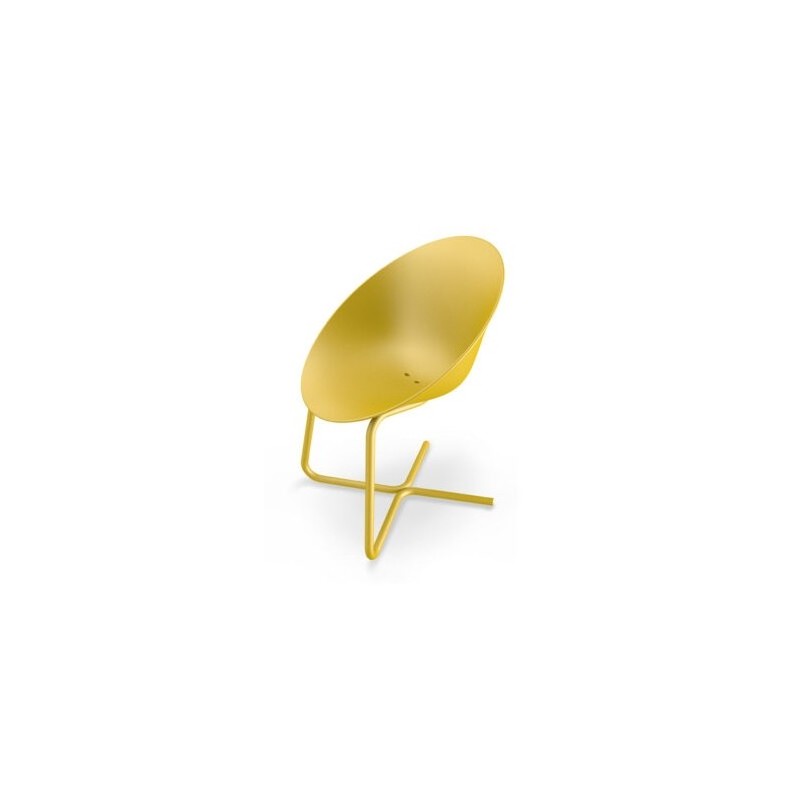
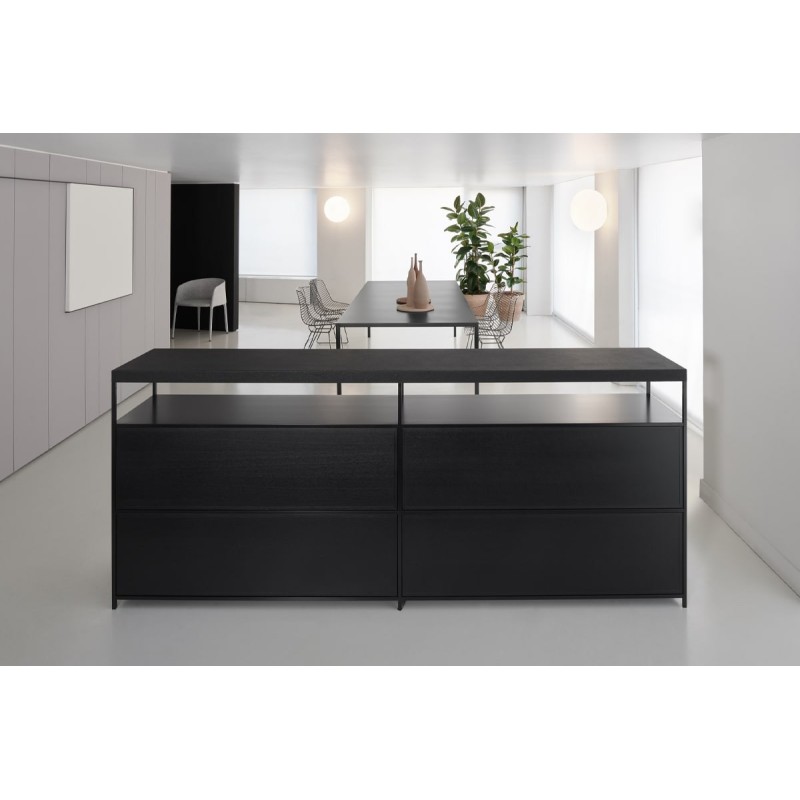
You only need to look at a contemporary dining room to find the Bauhaus. Cantilever chairs are everywhere, and many Italian companies reinterpret them: Cattelan Italia’s Scarlett has a frame made from a single steel bar, the same company’s Rachel stands on an arched base, Casprini’s Azhar combines steel tube with a polypropylene shell, and Moroso’s Rift, designed by Patricia Urquiola, brings the cantilever principle to plastic. Modular systems too, such as MDF Italia’s Minima 3.0 sideboard in extruded aluminium, descend from the Bauhaus idea of modular, industrial furniture. All these models are in the Arredare Moderno catalogue.
How to furnish in Bauhaus style
Few pieces, well chosen. Start from a neutral base of white, greys and black, the register you will find in our article on black and white interiors, and add accents in primary colours: a red rug, a yellow lamp, a blue cushion. Choose chrome or painted metal, glass, pale wood and leather, with clean geometric shapes. A cantilever chair at the dining table, modular shelving and a glass table lamp are enough to set the tone of a room.
To discover more design icons, see our guides to famous design armchairs and to the most popular modern furniture brands. The relationship between architecture and furniture is at the heart of our article on famous Italian architects, while the history of everyday furniture is told in who invented the bed and who invented the sofa.
Frequently asked questions
What does Bauhaus mean?
Literally “building house”, from the German bauen, to build, and Haus, house. It is the name of the school Walter Gropius founded in Weimar in 1919.
Who invented the cantilever chair?
The first tubular steel cantilever chair prototype was by the Dutch architect Mart Stam in 1926. Mies van der Rohe and Marcel Breuer developed famous versions in the following years.
What are the colours of Bauhaus style?
White, black and greys as a base, with accents in the primary colours red, yellow and blue, often paired with simple geometric shapes.
Why is the Wassily chair called that?
In tribute to the painter Wassily Kandinsky, Breuer’s colleague at the Bauhaus, who owned one. The name was chosen in the 1960s, when Dino Gavina put it back into production.
Does the Bauhaus still exist?
The school closed in 1933, but the Dessau building is now home to the Bauhaus Dessau Foundation and can be visited. The Weimar and Dessau sites have been a UNESCO World Heritage Site since 1996.
For the full history of the school, see the Bauhaus entry on Wikipedia.