
Cattelan Italia: history, designers, icons and 2026 collection
DESIGN ICONS | CHAPTER 01
Cattelan Italia is an Italian furniture company founded in 1979 by Giorgio and Silvia Cattelan, based in Carrè, in the province of Vicenza. From sculptural tables to modular bookcases, its collection explores the relationship between materials, function and the home.
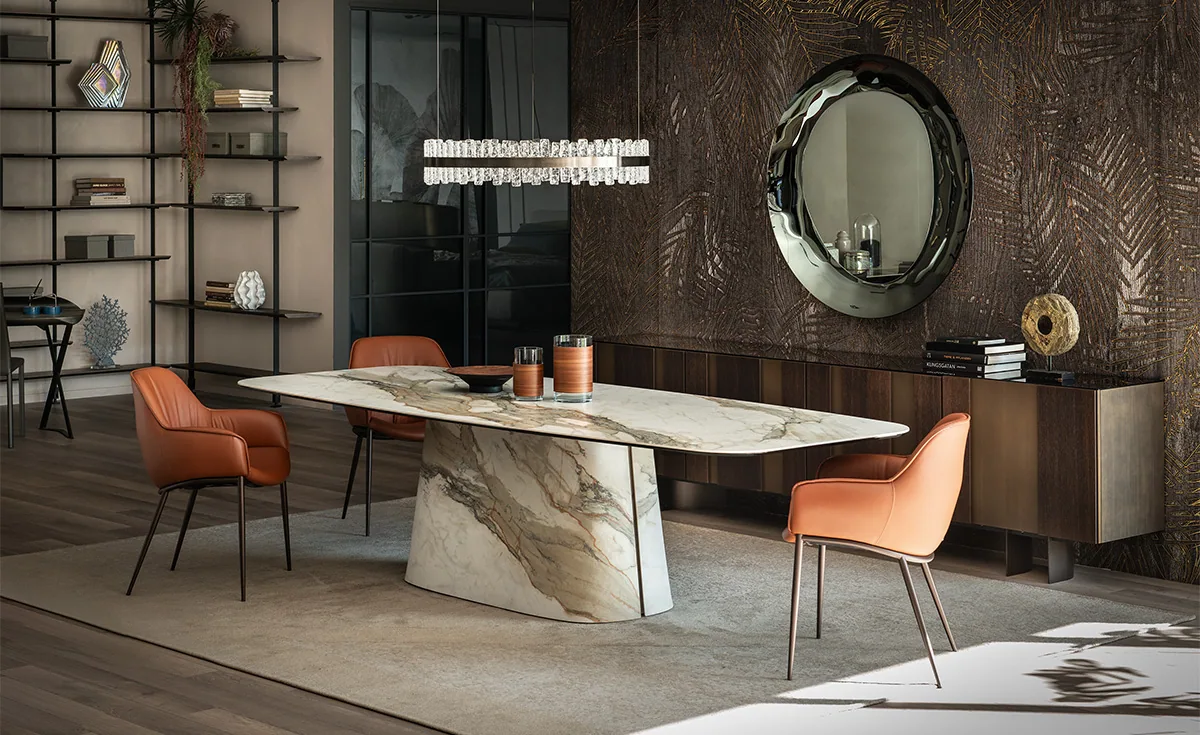
First, your eye falls on the top. Then it travels down to the base, and you pause: interwoven steel, a ceramic-clad curve, a balance that shifts as you move around the room. Looking at a Cattelan Italia table often means making this small journey around an object. Its profile matters as much as its surface; the empty space beneath the top becomes part of the design.
That attention to detail is our starting point. Understanding a brand means discovering the people, decisions and techniques behind its furniture. It also means imagining how those pieces might become part of our lives: a dinner with friends, a book left open, the pleasure of coming home.
This first chapter of Design Icons explores one of the names in our selection of modern furniture brands to know: its history, designers, signature pieces and new designs for 2026.
The history of Cattelan Italia: the roots of a vision
Before the company, there was a workshop. Giorgio Cattelan grew up in his father’s woodworking workshop: observing and transforming materials came before the brand itself. In 1979, he founded Cattelan Italia with Silvia. The first marble and glass tables established a direction that combined visual presence with experimentation.
In 1982, the first factory opened in Carrè. Sons Paolo and Lorenzo later joined the company; in 2011, it acquired Arketipo, the Florentine upholstered furniture specialist. Paolo Cattelan has led the brand since 2014. The official history of Cattelan Italia traces this continuity between a family business and design research.
The objects themselves record its milestones: Teso by Modus Studio, 1980; Lara by Giorgio Cattelan, 1984; Zig by Bruno Munari and Giorgio Villa, 1990; and the Dylan bed by Andrea Lucatello, 2007. The variety within the archive invites us to look beyond any single furniture category.
Cattelan Italia’s design language: materials, light and proportion
To understand Cattelan Italia’s design, look at how the different parts interact. A table’s broad, expansive top may contrast with a base that introduces tension and movement. A sideboard’s storage volume becomes a surface across which light changes direction. In bookcases, uprights and shelves organise a room partly through what they leave visible.
The materials palette includes wood, glass, ceramic, metal, leather and fabric. The hand-brushed Brushed finish catches the light differently from a uniform lacquer. CrystalArt explores decoration printed onto glass. Keramik denotes ceramic surfaces, including finishes inspired by marble and other stones: it does not mean natural marble.
It is worth distinguishing materials even when they look similar in photographs: marble-effect ceramic and natural marble have different identities. When choosing furniture, consider the actual material, finish and guidance in the relevant technical specification. A surface name tells only part of the story. To compare the way finishes respond to light and their care requirements, our guide to matt or glossy ceramic dining tables helps you assess a sample beyond its photograph.
Cattelan Italia designers and collaborations
The brand’s identity emerges from a dialogue between the Cattelan family and designers with different sensibilities. These attributions identify the people behind some of its most representative pieces:
- Giorgio Cattelan: designer of the Airport bookcase, a 2014 project.
- Paolo Cattelan: designer of Napoleon Keramik, 2024, and, with Andrea Lucatello, Skorpio Keramik, 2015.
- Andrea Lucatello: designer of the Kayak sideboard, 2009, and the Dylan bed, as well as a collaborator on the Skorpio family.
- Philip Jackson: designer of the Spyder table, recognisable by its X-shaped base.
- Castello Lagravinese Studio: creator of the Ruby family, expanded with a sofa in 2026.
Seen together, these designs range from the compositional freedom of a bookcase to the faceted surfaces of a storage piece and seating for homes and hospitality spaces. A shared language does not erase their differences: the dialogue between these designers gives the collection its depth.
Iconic Cattelan Italia furniture: five designs that explain the brand
Skorpio Keramik: geometry that sets the scene
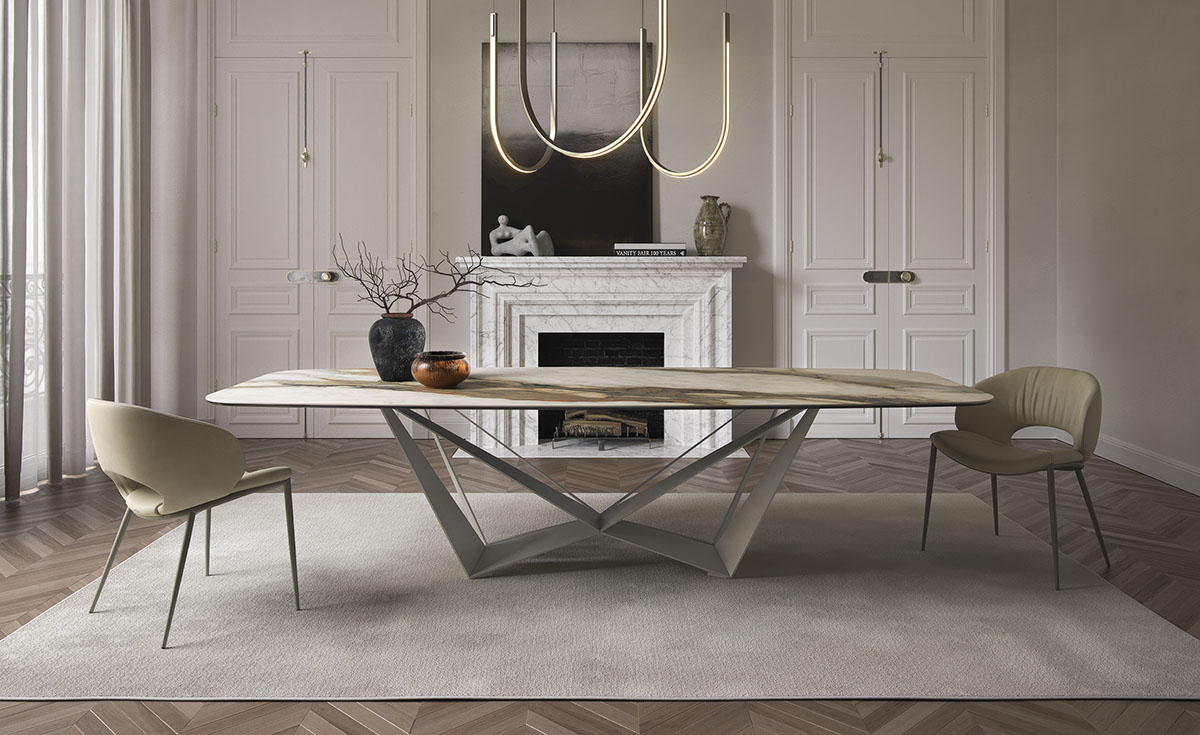
Design: Paolo Cattelan and Andrea Lucatello, 2015. Skorpio Keramik’s character lies in the meeting of its ceramic top and steel base: a complex geometry that invites you to view the table from different angles. The base establishes a visual rhythm and makes the profile recognisable even from a distance.
The Skorpio family has grown over time to include tops in different materials and round versions. For an interior project, its appeal lies in the possibility of starting with a distinctive form and interpreting it through shape, size and finish. A light top and a dark one can create very different atmospheres while retaining the same base design. The project’s evolution and designers are documented in the official Skorpio family brochure.
Spyder: the balance of an X
Design: Philip Jackson. Spyder concentrates its design into one immediately legible gesture: an X-shaped steel base. In the glass-top version, the structure remains visible and the table can almost be read as a drawing in space.
The family also includes wood and ceramic tops, which change the relationship between transparency and mass. It is a clear example of how materials can alter the perception of the same piece. In a dining room, consider the table alongside chairs, flooring and lighting: that is where its geometry finds its balance.
Airport: the bookcase that shapes a room
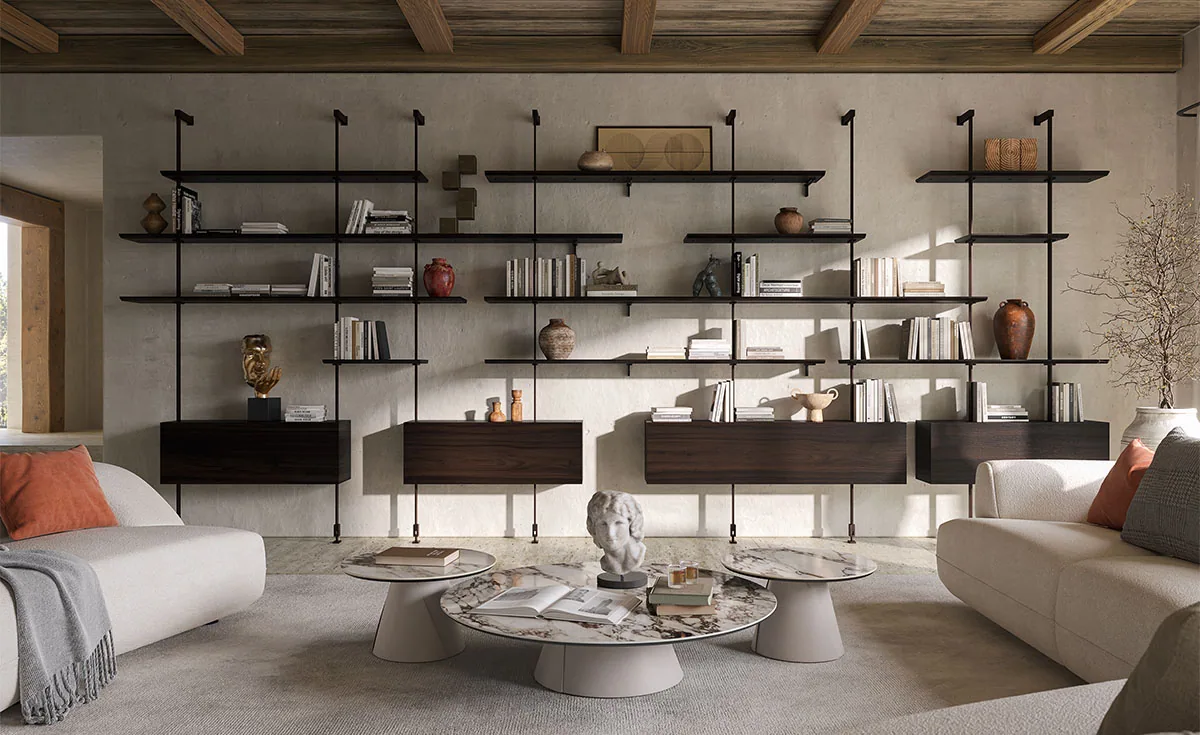
Design: Giorgio Cattelan, 2014. Airport is a modular system with wall or ceiling fixings. It can be arranged along a wall, around a corner or in the centre of a room as a divider. Uprights, shelves and storage units allow for different compositions.
Its strength lies in the relationship between solid and empty space. Books and objects become part of the design, but the intervals between shelves matter too. In an open-plan interior, this type of bookcase can suggest a division while preserving a visual connection between areas. Assess that possibility alongside the furniture layout and fixing requirements. The Airport product information describes the system’s possibilities.
Kayak: storage becomes a surface
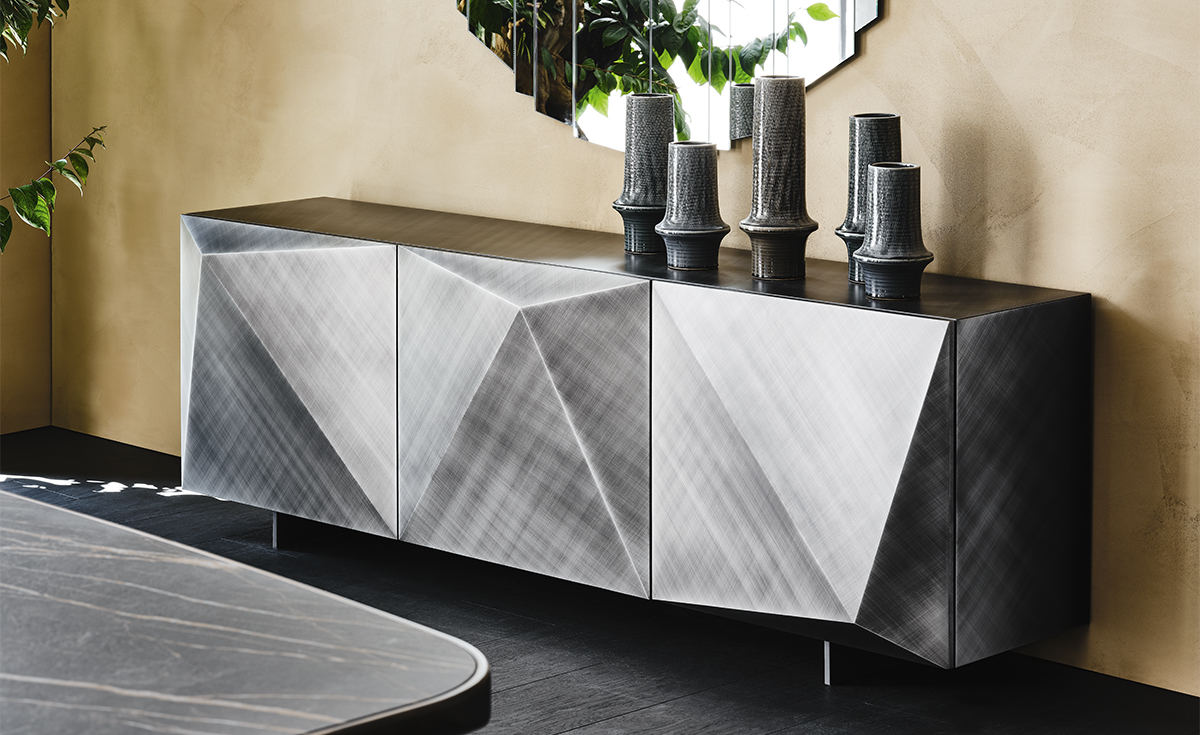
Design: Andrea Lucatello, 2009. The facets across Kayak’s front give it an immediate presence: light meets different angles, creating a rhythm of reflections and shadows. Brushed Bronze and Brushed Grey finishes emphasise this quality, changing the way the sideboard is perceived throughout the day.
Inside, it remains a storage piece, with clear glass shelves and two- or three-door configurations. To bring out its design, we suggest allowing the wall some breathing space: a few carefully chosen objects on top and considered lighting help reveal the front’s detailing. To place Kayak in context, it is also useful to consider how to coordinate a sideboard and dining table (in Italian), without expecting every surface to match.
Napoleon Keramik: ceramic takes on a curve
Design: Paolo Cattelan, 2024. With Napoleon Keramik, the research moves from the top to the base. Ceramic slabs are curved to clad two symmetrical shells: the base acquires a visual continuity that suggests a monolith, despite its more complex construction.
A vertical recess on the short side interrupts the surface and reveals the design. This is the detail to examine closely: it shows how a material associated with flat surfaces can become volume. Napoleon belongs to the direction introduced in 2024 and still developed in the current collection, including through new finishes. The base’s construction is explored in the official presentation of Napoleon Keramik.
Cattelan Italia around the world: three documented projects
Cattelan Italia furniture appears in residential projects and professional spaces, not only in catalogue settings. Three examples show how architects and interior designers select and combine its pieces. The presence of its furniture does not mean Cattelan Italia designed the building or the entire interior.
Lutron European Experience Center, London: design in a professional setting
In London, United Kingdom, the Lutron European Experience Center occupies 585 square metres dedicated to the brand’s solutions for residential and commercial spaces. Inova Contracts documents its collaboration with Aukett Swanke Architects and its involvement from furniture selection through to delivery and installation.
Cattelan Italia is listed among more than twenty European manufacturers involved in the supply. The project description published by Inova Contracts confirms its presence without identifying individual models: a documented example of the brand’s furniture in a professional setting.
An apartment in Krasnaya Polyana, Sochi: a dialogue with the landscape
In Krasnaya Polyana, in the Sochi area of Russia, BELOVEHOUSE, the studio of Ekaterina Belova and Yuri Belov, interprets an apartment through natural materials and an atmosphere inspired by mountain homes. The project account published by Cattelan Italia identifies the Peyote coffee table, Varenne console, Nelson bed and Miranda ML chairs among the furniture.
The transition between living and sleeping areas is particularly interesting: the brand’s character emerges through different objects within a wider composition, rather than solely through a statement dining table.
Villa Andricciola: Airport helps organise the interior
In Villa Andricciola, a project by IPAstudio and architect Paolo Isabella, the Airport bookcase separates the entrance from the living room. The Skorpio Keramik Premium table, Kayak sideboard, Magda chairs and Arcadia stools complete the social spaces.
The presentation shared by the architect identifies the furniture and its role: the bookcase helps organise the open-plan space, while the table and sideboard establish a dialogue between geometry and finishes.
The brand’s own spaces: Carrè and Milan
Completed interior projects should be distinguished from the brand’s exhibition spaces. The company showroom in Carrè covers approximately 3,000 square metres; the first company flagship store in Milan, at Via Larga 23, opened in 2024. Complete room settings reveal proportions and combinations, offering a useful reference before imagining the pieces in another home.
Cattelan Italia today: the 2026 collection
Cattelan Italia’s Book 10 brings together the 2026 collection, characterised by soft lines, fluid forms inspired by nature and a livelier use of colour. The catalogue was updated in September 2026: the evolution concerns both new objects and new interpretations of interiors.
Taj Mahal: a new light for the Keramik family
Introduced among the 2026 additions, Taj Mahal is a ceramic finish inspired by the Brazilian quartzite of the same name. A champagne-coloured background, amber veining and a paler network of lines create a warm, luminous surface. The finish expands the possibilities for tables, sideboards and desks, also appearing in curved ceramic bases. It is ceramic inspired by stone, an important distinction when reading the collection.
Gibson and Craig Supersoft: a more enveloping living room
Among the designs dated 2026, the Gibson sofa explores modularity through elements of different heights and depths. Double-sided configurations offer interesting possibilities for large interiors; movable armrests that can serve as backrests add flexibility. Optional stitching evokes the strings of the guitar that gives the design its name.
Craig Supersoft takes a rounded, continuous profile, with a particularly soft fibre-filled seat. Looking at the two sofas together reveals how the brand’s research extends into living-room habits: talking, changing position, finding support and taking time out. When comparing these configurations, the usable seat depth of a sofa matters as much as its overall dimensions.
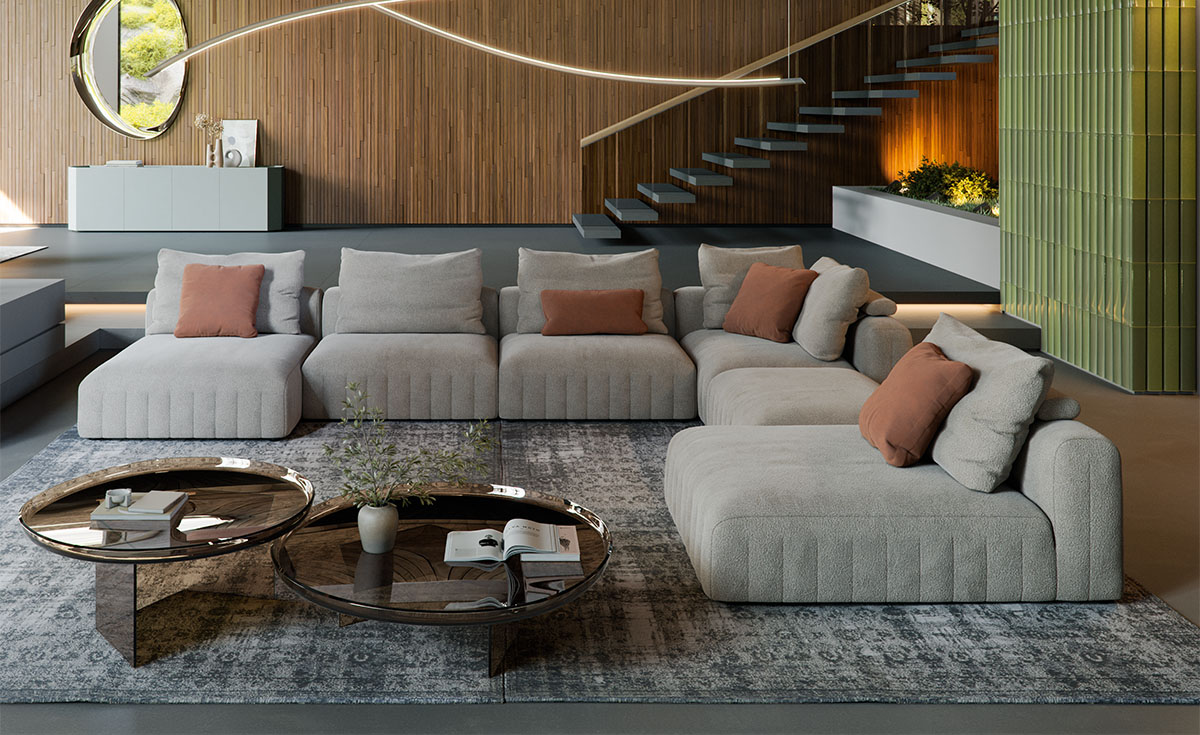
Ruby: extending the research into hospitality
The Ruby family, designed by Castello Lagravinese Studio, expanded in 2026 with a sofa coordinated with the armchair. A wooden structure, upholstered volumes and an enveloping backrest define a system also intended for lounges and reception spaces. The press office announcement introducing the Ruby sofa clarifies its designers and intended settings.
Margaret Turn: comfort from another perspective
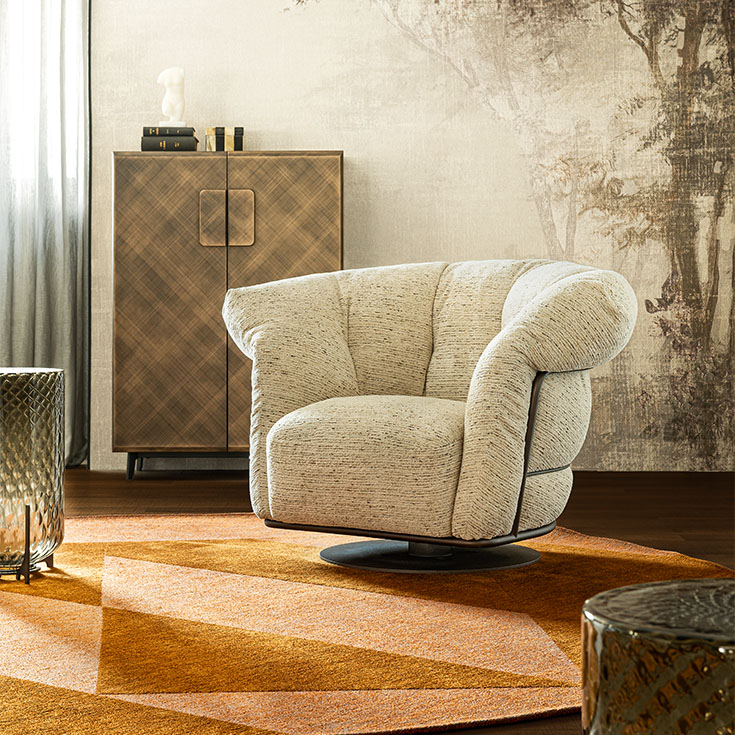
In the catalogue update announced on 10 September 2026, Cattelan Italia highlighted Margaret Turn, the swivel version of the Margaret armchair. Its tubular metal structure supports generous upholstery, while the backrest and armrests create an enveloping outline. Movement adds an everyday gesture to the design: turning towards a conversation or changing your viewpoint without getting up. The update is recorded in the official news about the 2026 collection.
Bringing this design language into your home
Our advice is to begin with one considered choice. A table with a complex base can become the focal point around which a dining room takes shape; a faceted sideboard can give a wall character; a modular bookcase can help rethink an open-plan interior.
Before choosing a finish, assess proportions: space around the table, the movement of chairs and circulation through the room. For round tables, comparing chairs, tabletop diameter and base clearance helps establish how many places are genuinely usable.
The direction of light and existing materials then guide the choice of surfaces. Comparing samples, dimensions and technical specifications helps translate inspiration into a configuration that works with your home: pleasing to look at and enjoyable to use.
ArredareModerno.com is an authorised Cattelan Italia retailer
ArredareModerno.com is an authorised Cattelan Italia retailer. Our perspective comes from working with the brand every day: understanding the differences between models, materials and configurations helps us describe its furniture with care. This series focuses on design culture, the people and the objects that make it recognisable.
That is the thread connecting a bookcase designed to form compositions within a room, a table exploring curved ceramic and an armchair that turns: shaping a home that rewards a closer look and finds its meaning in being lived in.
Sources, editorial verification and credits
Updated on 10 October 2026. Dates, design credits and new releases have been checked against the manufacturer’s documentation. The featured projects refer to accounts published by the brand, architect or furniture supplier. Models, locations and completion dates are not attributed unless stated by those sources.
Further product references: Spyder, Kayak, Gibson, Craig Supersoft and Margaret Turn.
Product photography: Cattelan Italia. The images are manufacturer-created settings, not photographs of the three projects described. The Napoleon Keramik and Airport photographs come from the ArredareModerno.com editorial image library.