
Design pellet stoves: where to place them and how to choose
Slim models for hallways, round ones for corners, ducted systems that warm more than one room: how to choose a pellet stove that also works as a piece of furniture, and where to place it in the living room.
Design pellet stoves are now chosen the way you would choose a statement piece of furniture: for shape, finish and position in the room as much as for heat output. Italian manufacturers even organise their ranges by placement (models for a wall or the middle of the room, slim versions with a shallow depth for narrow spaces, round models for corners) and by heating type, either warm air for one room or ducted air sent to other rooms.
The practical rule is simple. Start from the spot where the stove can be installed safely, which means where the flue runs or can run, and only then plan the furniture around it. A well placed stove becomes the focal point of the living room; a badly placed one means rearranging sofas and shelving for years.
In short
- Find the technically suitable spot first (flue route, power socket, clearances set by the manufacturer), then design the room around it.
- Air stoves heat one room well, including open plan spaces; ducted stoves send warm air to other rooms through small ducts.
- Slim versions have a reduced depth and suit hallways and narrow rooms; round models make use of corners.
- Common finishes are steel, ceramic and majolica, stone, porcelain stoneware and cast iron: choose them together with the floor and wall.
- Installation must follow local regulations and is a job for a qualified installer.
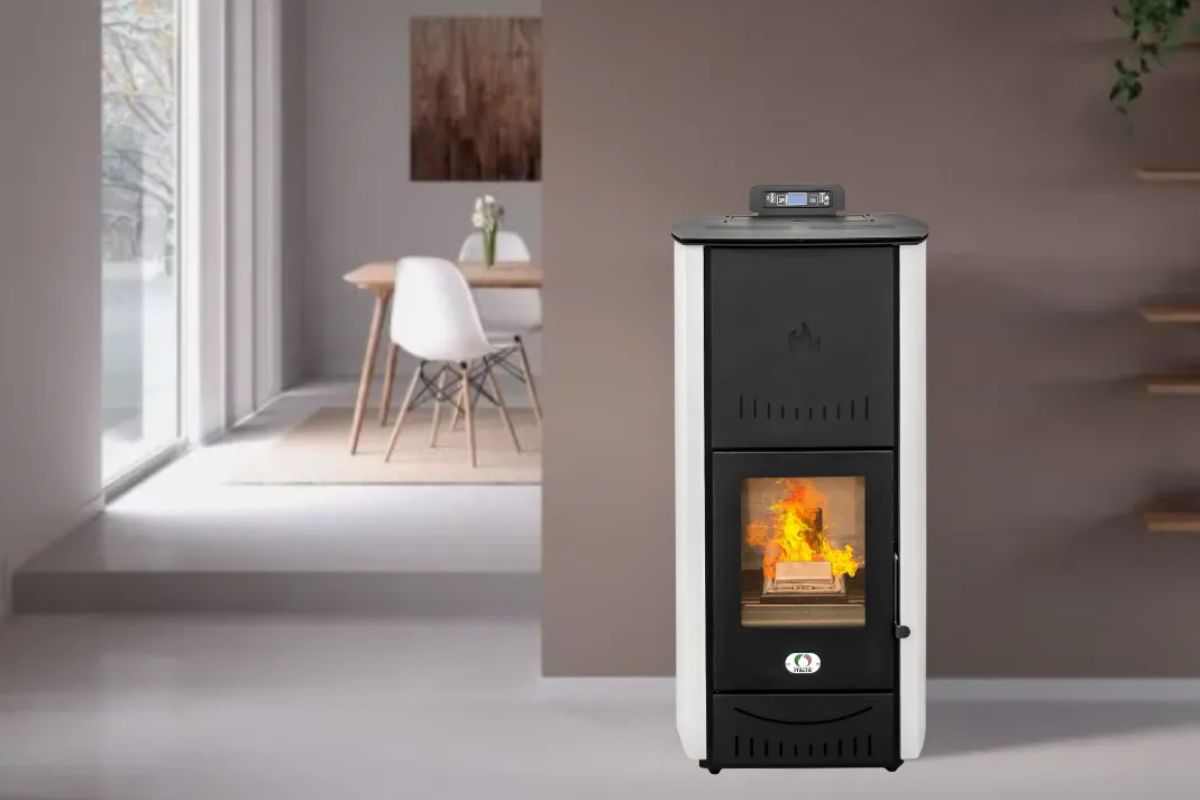
Where should a pellet stove go in the living room?
A pellet stove should go where it can vent its flue gases correctly and where its heat reaches the part of the room you use most, usually the sofa area. Pellet stoves use forced venting: a combustion blower pushes exhaust out through the vent, as the Wikipedia entry on pellet stoves explains. That is why position depends on the flue first and on looks second.
Within the possible positions, a few design criteria help:
- Against a clear wall: the tidiest option. The wall behind the stove can become a textured backdrop in stone, lime plaster or a deep colour.
- In the middle of the room: possible with models finished on all sides, and useful in open plan layouts to separate kitchen and lounge.
- In a corner: round or corner models reclaim a space that often goes unused.
- In a hallway or passage: this is where slim stoves, with their shallow depth, come in.
Three practical details affect the furniture plan more than you might expect. The stove needs electricity for ignition, the auger and the fans, so plan a nearby, discreet socket. Pellets are loaded from a hopper, usually from the top, so avoid low shelves above the stove. Clearances from curtains, sofas and wooden furniture are given in each model’s manual; your installer will check them on site.
Slim pellet stoves: which rooms are they for?
Slim stoves are designed for hallways, entrances and narrow living rooms because they are much shallower than standard models. MCZ, for example, has a dedicated “Slim” family and recommends it for corridors and tight spaces; Palazzetti offers a space saving range with reduced depth that can be installed flush with the wall.
In furnishing terms, a slim stove behaves almost like a wall element. It lines up with panelling, a low bookcase or a sideboard. Treat it as part of a composition rather than an object standing alone in the middle of a passage.
Air or ducted pellet stoves: what changes for the interior?
An air stove mainly heats the room it stands in, while a ducted stove also sends warm air to other rooms through small ducts. MCZ recommends its air stoves for heating a single room, large rooms and open plan spaces included, and on many models offers a function that reduces or switches off forced ventilation for quieter running.
Ducted stoves are almost small heating systems, and the vents become a design issue. Two examples checked on the manufacturers’ own websites:
| System | How it distributes air | What it means at home |
|---|---|---|
| MCZ Comfort Air | Ducts with a 60 mm cross section, up to 8 metres, which can run through non load bearing partitions | Minimal vents that double as wall lights and can be placed freely |
| Palazzetti AirPro | Up to 28 metres of ducting (two channels of up to 14 metres each) | Heat reaches 2 or 3 rooms, even on different floors, with adjustable temperatures |
If you go for a ducted stove, decide where the vents will sit at the same time as you plan lighting and artwork, so they do not end up behind a wardrobe or above a headboard.
How do you match a pellet stove to your interior style?
Style comes from shape and finish: square lines and steel for contemporary rooms, ceramic and majolica for classic ones, stone and cast iron for rustic and mountain interiors. Manufacturers follow the same logic. On the MCZ website some models are described as classic in style and others as having an essential design, with finishes ranging from steel to ceramic side panels, from porcelain stoneware to cast iron combined with steel.
In traditional homes and warm interiors, majolica is still a stove with character. The Piazzetta Group presents majolica as the cladding for its stoves and fireplaces, worked and finished by hand so that each piece is different. In a mountain chalet, a stone or cast iron stove sits well with pale wood and natural fabrics, as we describe in our guide on how to furnish a Nordic style mountain house.
Minimal interiors work best with contrast: a dark steel stove against a pale wall, or a light coloured stove against a charcoal one. If you want a deep but not gloomy wall behind the stove, a slate grey colour scheme is a versatile base that sets off the flame.
Which finishes suit a modern pellet stove?
For a modern look the most common finishes are steel, porcelain stoneware, stone and glass on the front, chosen to match floor and wall. Each material behaves differently in a room:
- Steel: clean lines and neutral colours, good with concrete, resin and dark woods.
- Ceramic and majolica: glazed surfaces and solid colours for classic, country or eclectic rooms.
- Stone: stone fronts add visual weight and suit country and mountain homes.
- Porcelain stoneware: a textured look with easy care, handy if the floor is already in stoneware.
- Cast iron: a nod to the traditional stove, ideal in rustic living rooms.
Controls are part of the design too. Many models can be run by remote control or app, such as the Palazzetti App mentioned by the manufacturer, and MCZ ducted systems let you set temperature and ventilation room by room. A stove without a bulky control panel on top looks cleaner.
Are design pellet stoves also a subject of research?
Yes, the industry works on design with universities. Edilkamin, for example, ran a Design Workshop Week with the Politecnico di Milano from 3 to 7 June 2024 on new ideas for biomass heating. Student projects included a stove with a removable transparent hopper, a tall stove designed as the focal point of the living area and a pellet stove that can be built into a kitchen base unit. These are concepts, not products on sale, but they show where the idea of the stove is heading: less appliance, more furniture.
How do you furnish the living room around the stove?
Furnish the area around a pellet stove as you would around a fireplace: seating facing the flame, easy clean surfaces on the floor, natural materials and warm light. A few concrete ideas:
- a natural fibre rug, kept at the distance set by the manufacturer;
- a bench or low pouffe to sit near the fire without cluttering the room;
- a closed storage unit for pellet bags, close by but not touching the stove;
- a floor lamp with warm light for evenings when the stove is off.
To compare sofas, sideboards and accessories before deciding, one reference is the Arredare Moderno catalogue, useful for checking proportions and finishes.
What about technical rules?
Installation, inspection and maintenance of pellet stoves are governed by national and local regulations, which differ from country to country. Do not treat them as a DIY matter: flue, clearances and ventilation should be defined by a qualified installer on the basis of the manual for the model you choose.
Frequently asked questions
Can a pellet stove go in a small living room?
Yes, as long as there is a suitable spot for the flue. Slim and corner models are designed precisely for small spaces.
Are the vents of a ducted stove visible?
They are, but some manufacturers design them as decorative pieces: MCZ, for instance, offers vents that also work as wall lights.
Do you need a socket near the stove?
Yes. A pellet stove uses electricity for ignition, fuel feed and fans, so plan a dedicated, hidden socket at the design stage.
Sources
- Wikipedia, “Pellet stove” (hopper, auger, fans, electricity, venting)
- MCZ, official pages on ducted and air pellet stoves, mcz.it (accessed 18 October 2026)
- Palazzetti, official pages on pellet stoves and AirPro, palazzetti.it (accessed 18 October 2026)
- Piazzetta Group, official website, gruppopiazzetta.com (accessed 18 October 2026)
- Edilkamin, page on the collaboration with the Politecnico di Milano, edilkamin.com (accessed 18 October 2026)