

Left- or right-hand chaise sofa? Plan the room before choosing
A chaise looks inviting on either side of a sofa until you try to reach the balcony. In a compact living room, choosing the wrong configuration can mean walking around the sofa every time you cross the space. When deciding between a left- or right-hand chaise sofa, start with the routes through the room rather than the arrangement that looks best in a photograph.
The chaise should extend on the side that keeps entrances and other furniture usable. Before ordering, also establish how the supplier defines left and right. The label alone is not a substitute for a drawing of the exact configuration.
Left or right from whose viewpoint?
You might describe the chaise as right-hand while looking at the sofa from the front. Someone else might interpret the same words from a seated position. Do not leave this to an unspoken convention. Open the model’s plan drawing and identify the extended section physically.
The clearest method is to compare a plan of the room with a plan of the sofa, both facing the same way. Mark the door, window and television. Ask the retailer to confirm that the ordered configuration matches that drawing.
Terms such as chaise, corner unit and terminal unit can also refer to different components within a modular collection. Check which piece the supplier actually means rather than assuming that every extended seat is interchangeable.
Draw the main walking route first
Trace the routes from the living room entrance to the places you use most: the kitchen, balcony, dining area and hallway. Every route need not be perfectly straight, but it should remain practical when someone is sitting or reclining on the sofa.
Do not assess the chaise as an empty rectangle on the floor. Include a nearby coffee table, a reclining person’s feet and the opening space of cabinets. A workable seating area allows these activities to coexist.
For a wider view, use our guide to positioning a sofa and table in the living room. Sometimes the difficulty lies between the dining and sitting areas, not in the sofa alone.
The same room with two opposite configurations
Imagine a rectangular room with the sofa against one wall and a balcony door to its right when viewed from the front. The room entrance is at the opposite end. This is an illustrative example, not a recommended plan for every home.
Chaise towards the balcony
The extended section occupies the area closest to the outside door. If the remaining route is too narrow, anyone heading outside has to walk around it. The arrangement may look balanced from the front while being inconvenient in use.
Chaise on the quieter side
Reversing the configuration may leave a more direct route to the balcony. But now check the other end: the chaise might block a dining chair, shelving unit or opening door. Moving the obstacle is useful only if its new position works better.
That is why there is no universally preferable side. The best choice is the one that accommodates the room’s most frequent activities, not simply the one that mirrors a showroom display.
Which sofa dimensions belong on the floor plan?
Record overall width, the depth of the main sofa body and the full depth at the chaise. Include projecting arms, angled backs and any headrests that move. These details can change the maximum footprint.
A width of 280 cm does not tell you how far the chaise reaches into the room. Plot width and depth separately. Our explanation of sofa dimensions and types helps distinguish these measurements.
For reclining functions, add the open configuration too. A route that is clear with every mechanism closed may become restricted when the sofa is actually being used. Judge the everyday arrangement, not only its tidiest position.
Consider the television, window and coffee table together
The chaise often becomes the favourite television seat. Before choosing its side, check the view of the screen. A position that is pleasant for stretching out may be less comfortable if it requires keeping your head turned for long periods.
Consider daylight and access to the curtains as well. If part of the sofa sits beneath a window, check opening sashes, handles and radiators. Our guide to placing a sofa under or in front of a window explores those constraints.
Choose a coffee-table footprint that suits the space left over. The area inside an L-shaped arrangement is not automatically free for furniture: people still need to reach their seats and get up.
Does a reversible chaise remove the uncertainty?
It can offer flexibility, but find out what “reversible” means for that particular model. You may be able to move an independent section, or the change may require a different combination of components. Not every chaise can switch sides after purchase.
Ask which parts are involved, whether additional accessories are needed and what operations the manufacturer permits. Reversibility does not remove the need for room planning: both positions must remain usable.
A documented modular system may be attractive if you expect to move home or rearrange the room. Assess the connectors, individual module dimensions and available variants rather than assuming unlimited combinations.
When a straight sofa and footstool make more sense
If neither side works, do not force a chaise into the room. A straight sofa with a separate footstool can allow a route to be cleared when needed. That may suit a living room whose use changes throughout the day.
The footstool still needs somewhere to go when it is not in front of the sofa, and moving it should be practical. It is a flexible alternative, not a way to make the extra footprint disappear.
Before sending the order
- Draw the exact configuration rather than a similar-looking sofa.
- Mark the viewpoint used for left and right.
- Try the routes with the seating area and other furniture in use.
- Include doors, curtains, cabinet fronts and reclining functions.
- Have the retailer confirm the drawing associated with the ordered product code.
Choosing the side is not a finishing detail. When it is right, you barely notice it: you move through the room naturally and use the chaise to relax, rather than treating it as an obstacle.
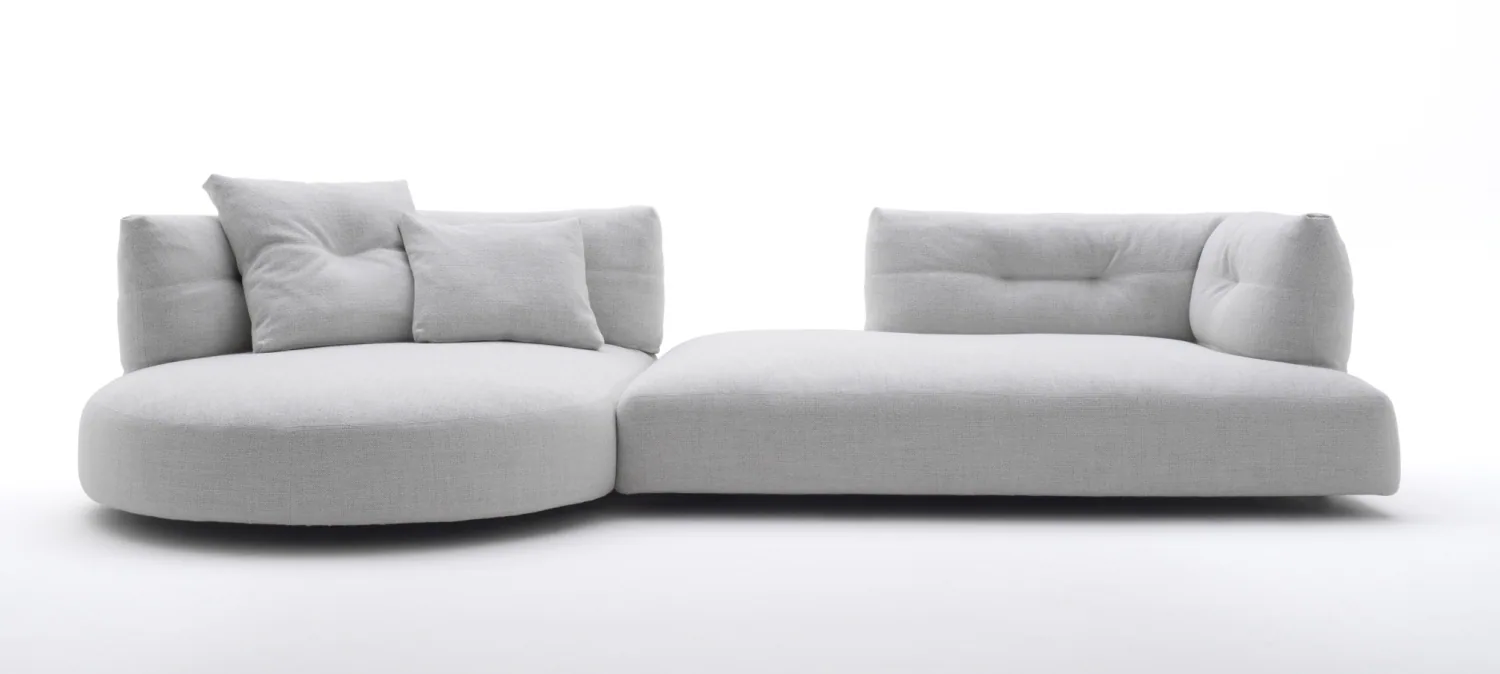
Featured image: Dorvan, Desiree. The chaise is on the right when looking at this sofa from the front; the confirmed configuration drawing determines the order. Photo credit: www.arredaremoderno.com.