

Matt or glossy ceramic dining table: which finish suits everyday life?
In a showroom, a glossy ceramic tabletop can catch your eye immediately. The matt version beside it may look quieter against the same chair or floor. But choosing a matt or glossy ceramic dining table is about more than deciding which looks more elegant.
Compare how the finish behaves in light, how marks and residues become visible, how it works with other materials and what care the specific surface needs. Matt and glossy do not, by themselves, define the strength or quality of a tabletop. The exact product specification matters.
Start with light and reflections
A glossy surface produces more defined reflections that can emphasise veining, windows and lamps. That may be exactly the effect you want in a restrained room. In a space already full of reflective surfaces, it can become another strong visual element.
A matt finish tends to give a more even reading of the surface. It is not necessarily visually flat: texture, colour and low-angle light can reveal different details. Nor does “matt” automatically mean subtle if the pattern has strong contrasts.
Look at a sample from a seated position as well as from the doorway. A tabletop is seen from many angles, not only directly above. If possible, consider it in the daylight and artificial light you actually use.
Visible fingerprints are not the same as damage
The visibility of a residue depends on colour, finish and the direction of the light. A plain dark surface and a pale, strongly veined one will not necessarily show the same marks in the same way.
It is therefore unhelpful to assume that matt ceramic “never looks dirty” or that a glossy finish “gets damaged immediately”. Removable dirt and a change to the surface are different issues. Both need to be considered in relation to the actual material.
Ask how the sample is maintained in normal use and request the approved cleaning instructions. Do not carry out scratching, abrasion or chemical tests without the manufacturer’s permission and guidance.
A comparison checklist for the real sample
| Aspect | Question to ask | What it clarifies |
|---|---|---|
| Light | Do windows or lamps reflect into your usual seated view? | How prominent the finish will feel |
| Colour and veining | How does the pattern read in each version? | The overall effect beyond the finish name |
| Visible marks | How do residues show under the room’s lighting? | Realistic expectations for daily upkeep |
| Cleaning | Which products and tools are permitted? | Whether your routine suits the surface |
| Edges and construction | How is the top built and what precautions apply? | The difference between appearance and performance |
Three everyday situations
A dining area beside a large window
Start by observing reflections from the seat you normally use. Gloss can create an attractive effect, but assess it at the times when you eat, read or work at the table. A standing view in a showroom does not answer that question.
Matt is an alternative worth comparing, not a guarantee that every source of glare elsewhere in the room will disappear.
A living room with several contrasting materials
With glass, polished metal and a patterned floor already present, decide whether the table should add another focal point or connect the existing elements. A quieter finish may help, but colour and veining remain just as important.
A heavily patterned matt top can be more visually assertive than an almost uniform glossy one. Choose the whole surface, not a finish label in isolation.
A table for meals, homework and occasional work
Here the practical routine matters: cleaning between activities, protecting the surface when using non-food materials and clearing space for different tasks. Ask for precautions specific to the product and use appropriate protection for the activity.
A general claim that ceramic can cope with anything is not a substitute for care instructions. Think about how the family uses the table on an ordinary weekday.
“Ceramic” does not describe the whole tabletop
Construction can vary, including ceramic surfaces bonded to other supporting materials. The apparent thickness of the edge, the thickness of the ceramic layer and the overall structure are not necessarily the same measurement.
Ask how the chosen top is made, what use it is intended for and what precautions apply to its edges and corners. Details for one product should not be extended to all ceramic tables.
Our article on ceramic table designs can help compare shapes and bases. For current technical characteristics, use the manufacturer’s information for the selected model and finish.
Follow the cleaning instructions for that surface
Before using a cleaner, sponge or surface treatment, establish whether it is suitable for the exact product. Do not transfer a routine intended for natural marble, timber or glass to ceramic without checking.
Material performance does not mean that precautions are unnecessary. Ask about daily cleaning, spills and any restrictions affecting edges or joins. If an approved method does not remove a mark, contact the supplier rather than trying progressively more aggressive products.
Choose the right dimensions before the finish
Neither matt nor gloss compensates for an oversized top or a base that obstructs the chairs. First check table dimensions for the number of diners, along with the room needed to pull out chairs and move behind them.
Then place the finish sample beside the chosen flooring and chair material. If you also need flexibility, compare extending tables and ask how the extension leaves are constructed and finished.
Which one should you choose?
Choose gloss if its reflections are a deliberate part of the scheme and work under the actual lighting. Consider matt if you prefer a different relationship with light and texture. In both cases, decide after comparing the sample, construction and maintenance requirements.
There is no universally superior finish. The right one still appeals when the table is being used every day, not just arranged for a photograph.
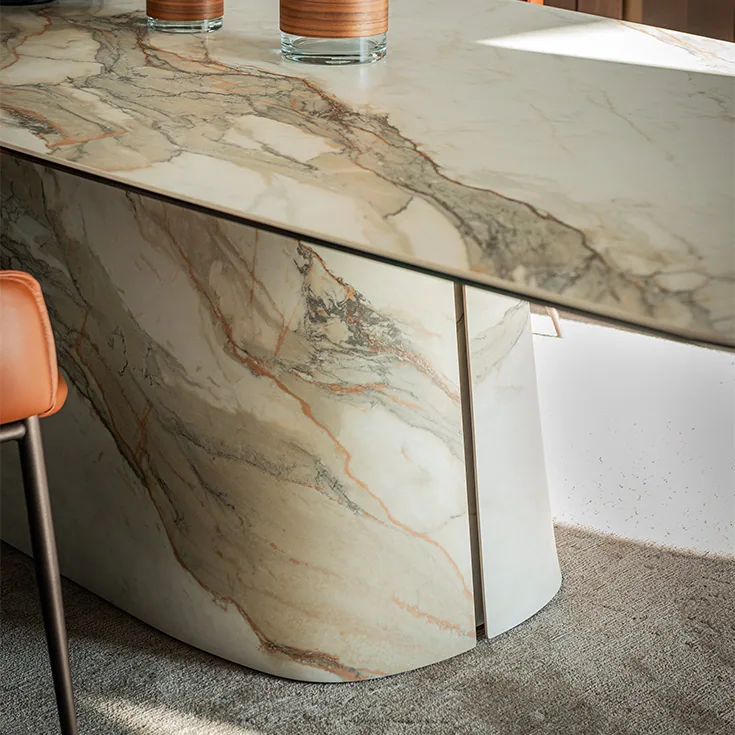
Featured image: Napoleon Keramik, Cattelan Italia. The photograph shows the overall ceramic effect; assess gloss and reflections on the selected finish. Photo credit: www.arredaremoderno.com.