

Chairs for a round dining table: check what happens underneath
A round table can look wonderfully spacious with the chairs pulled away. Push them in, however, and a different picture emerges: armrests meet the underside, chair legs gather around the pedestal and one place feels tighter than the others. Choosing chairs for a round table means checking the space underneath as carefully as the diameter.
Start with the number of people who sit there every day. Occasional extra places are a separate requirement, not a reason to make the normal arrangement uncomfortable.
Measure the widest part of the chair
The seat width is not necessarily the overall width. Curved arms, a flared back or angled legs can extend beyond it. Ask for the maximum width and depth, then compare those measurements with the actual area available around the table.
Imagine placing a 58 cm wide chair beside a slimmer 46 cm model. Multiplying that difference by several places quickly changes the arrangement. These are hypothetical widths, not recommended limits or measurements of the chairs pictured here. Use the exact specification of each candidate.
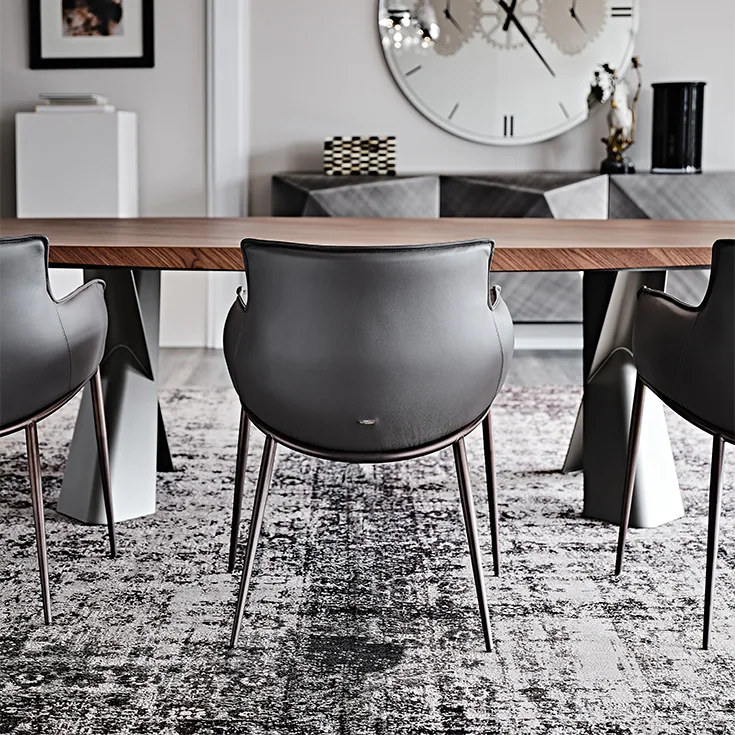
Why dividing the circumference is not enough
Dividing the edge of a round table into equal sections can help you sketch places, but it does not prove that the chairs fit. Chair bodies occupy depth as well as width; closer to the centre, their legs and the occupants’ knees converge. A comfortable arrangement at the outer edge may be crowded underneath.
Also allow room for elbows, place settings and serving dishes. Our guide to dining table sizes for 6, 8 and 12 people helps frame the capacity question, but the final test must use your table and chairs together.
The base can change everything
| Table base | What to check with the chair |
|---|---|
| Compact central pedestal | Foot room and how far the chair can slide in. |
| Wide sculptural base | Obstructions at knee and ankle height. |
| Four separate legs | Whether every seating position falls between them. |
| Radial feet | Where the chair legs land and whether feet collide. |
A central support does not automatically mean more usable places. Its maximum width at floor level can matter just as much as its visible width near the tabletop.
Armrests must clear the lowest obstruction
Compare the height of the arms with the underside of the table, including an apron or reinforcing frame. The top surface height alone is not enough. Upholstered arms may look soft but should not be forced against a hard edge to make the chair fit.
Check the entire sliding movement, not only the final parked position. Curved arms can touch before the seat reaches the place you expected. If the chair cannot tuck in, include its permanent projection in the room plan.
Test a complete seating position
If possible, try the proposed chair at the actual table. Sit normally, move your feet, turn slightly and stand up. Then repeat with a second person beside you. A single chair tested alone cannot reveal neighbouring armrests or competing foot space.
At home, mark the table outline and base on the floor. Use chairs or cardboard outlines that represent the real overall dimensions. Leave the route to the kitchen open and test it while someone is seated. For the wider arrangement, see placing a sofa and dining table in the living room.
Match materials without making the set visually heavy
A substantial table can work with visually light chairs, while a slender top can accommodate more enveloping seats. This is a design choice, not a sizing rule: an open back does not reduce the measured width of a chair.
Consider cleaning and contact points too. Check the upholstery care instructions and the protection recommended for the floor. Repeating one finish can connect the pieces without making every material identical.
Everyday seats and guest seats are different decisions
For daily use, keep the arrangement easy to enter and leave. For a rare gathering, additional chairs may involve a different layout, but they still need stable support and usable space. Before ordering, write down chair width, arm height, base footprint and the movement needed to stand up. A successful pairing is one you stop noticing as soon as dinner begins.
Featured image: Circus round table, Bonaldo. Photo credit: www.arredaremoderno.com.