

Sofa side table: height, size and design classics
It is small and usually bought last, yet it is the piece of furniture you reach for most while sitting down. Here is how to size the table next to your sofa and which design classics deserve a look.
A sofa side table works when you can reach the top without getting up or twisting round, which is why the right height is set by the sofa arm, not by the coffee table. In everyday interior practice the top sits level with the arm or slightly below it. The C-table is the exception: its base slides under the seat so the top hovers over your lap.
This guide covers only the table beside the sofa: shape, the measurements to take at home, materials and a handful of modern side tables whose maker and designer we checked against official product sheets. Heights quoted are those declared by the manufacturers; where no technical figure exists, we say so and describe common practice instead.
In short
- Choose the top height from the sofa arm: level with it or a little lower.
- The C-table is the exception, with a base that slides under the sofa and a top that rises above the seat.
- The main shapes are round, C-shaped and nesting or paired tables.
- Before buying, measure the arm, the seat and the clearance under the sofa.
- Reference designs include Eileen Gray’s E1027 (ClassiCon), Victoria Wilmotte’s Pli (ClassiCon), Soda by Miniforms, Gem by Bonaldo and Marcel Breuer’s Set B 9 (Thonet).
What is a sofa side table for?
It keeps the things you use while seated within easy reach: a mug, a book, the remote, a phone on charge, sometimes a lamp. The coffee table does a different job as a shared surface in front of everyone. The side table is personal and tied to one particular seat, so it pays to think seat by seat. If you always read in the right-hand corner, that is where you need a surface, not in the middle of the room.
In a small living room a side table can even replace the coffee table and free up the space in front of the sofa. In a large one, a table at each end gives the arrangement symmetry and gives every guest somewhere to put a glass down.
How high should a sofa side table be?
Side table height should be judged against the sofa arm. The most common approach is a top at the same level or slightly lower, so your hand drops naturally onto whatever is there without lifting the elbow. There is no single standard, because arm heights vary widely from one sofa to the next, so the figure to take with a tape measure is the arm itself, from the floor to its highest point.
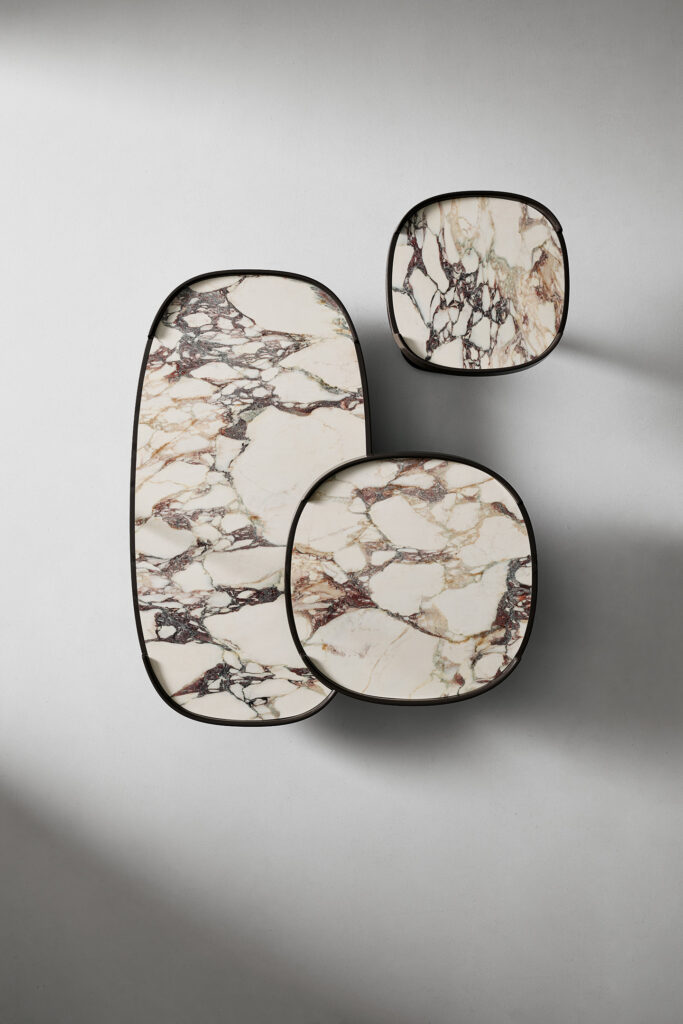
A top that is too low makes you lean forward; one that is much higher than the arm becomes a visual barrier and gets in the way of your elbow. Manufacturers’ sheets give a feel for real heights: Miniforms lists its Soda table at Ø 38 x 45, the high version of Bonaldo’s Gem measures 55 x 55 x 48 cm, and Miniforms’ Mastea reaches Ø 35 x 52. These are heights designed to sit beside a seat, quite different from low central tables, which we cover in our guide to choosing the right coffee table height.
How far from the sofa should it go?
Place the side table right against the arm, close enough to reach the top with an outstretched hand while seated. Manufacturers do not publish a fixed distance, so the most reliable test is to sit in your usual spot and check you can put a mug down without leaning. If the arm is very wide, the table can sit slightly forward, roughly level with your knee, as long as it does not trip up anyone getting up.
Which shape: round, C-shaped or nesting?
The right shape depends on how you use the sofa and how much space you have at each end. The three main families solve different problems.
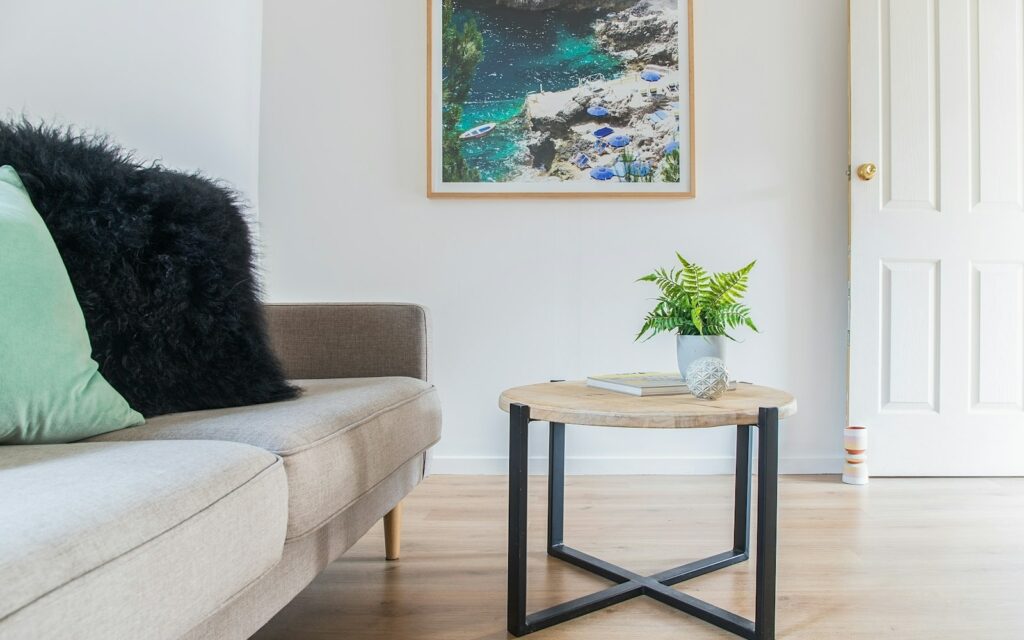
Round side tables
A round top has no corners, is easy to walk round and looks light. It is the most versatile choice beside a sofa, especially in tight walkways or homes with small children. A small top holds a mug and a book comfortably; if you also want a table lamp on it, go for a larger diameter.
C-tables
A C-table has a base that is open on one side: the foot slides under the seat and the top comes over your knees. It is ideal if you eat or work on a laptop from the sofa. Check two measurements first: the clearance between the floor and the sofa frame, where the base has to fit, and the seat height, which the top must clear comfortably. Sofas with a solid plinth down to the floor will not take one.
Nesting and paired tables
Nesting tables tuck one beneath the other and come apart when guests arrive. They suit compact living rooms because they take up the footprint of a single piece. Pairs of different heights create a stepped effect beside the sofa and let you split things up: the glass on the higher top, books on the lower one.
Which materials work best next to a sofa?
Pick the material with daily life in mind: glasses, hot mugs, dust. Powder-coated metal is slim and visually light; glass makes the arrangement feel airy but shows fingerprints; wood warms things up and sits well with upholstery; marble and ceramic are heavy and stable, useful if the table has to carry a lamp. Blown glass, as in several Miniforms designs, turns the table into a decorative object: lovely to look at, but best treated with some care.
To compare shapes and finishes before deciding, one useful reference is the Arredare Moderno catalogue, handy for checking sizes and materials of living room accessories side by side.
Which design side tables are worth knowing?
Some designs have become benchmarks precisely because of how they relate to the sofa. These are the design side tables we verified on the official product sheets.
- Adjustable Table E1027, Eileen Gray, 1927, ClassiCon. Height-adjustable chrome-plated tubular steel frame with a top in crystal glass, smoked glass or black lacquered metal. It takes its name from the house E 1027 that Gray built for herself and Jean Badovici. Details are on the official ClassiCon product page.
- Pli Side Table, Victoria Wilmotte, ClassiCon. A base of folded stainless steel sheet with an oval crystal glass top, available in two heights. The maker describes it as a side table for a sofa, armchair or bed.
- Diana, Konstantin Grcic, 2002, ClassiCon. A series of sheet steel tables, A to F, that work as side tables or laptop stands.
- Soda, Yiannis Ghikas, Miniforms. A single piece of blown glass, listed at Ø 38 x 45 in the taller version. The Miniforms product page makes clear it is a side table, not a stool.
- Gem, Bonaldo. A family of modular tables with glass or ceramic tops and a glossy lacquered wood edge; the high version measures 55 x 55 x 48 cm, a good match for most sofa arms.
- Set B 9, Marcel Breuer, 1925/26, Thonet. Nesting tables in chrome-plated tubular steel, originally designed for the cafeteria of the Bauhaus building in Dessau, according to Thonet.
Side table types, heights and when to choose them
| Type | Indicative or declared height | When to choose it |
|---|---|---|
| Compact round | Common practice: level with the arm or just below. Declared example: Soda, Miniforms, Ø 38 x 45 | Tight walkways, a spot for a mug and a book |
| Tall square | Declared example: Gem high, Bonaldo, 55 x 55 x 48 cm | Sofas with clean lines, room for a table lamp |
| Tall and slim | Declared example: Mastea, Miniforms, Ø 35 x 52 | High arms, reading corners |
| C-table | The top must clear the seat; ClassiCon’s E1027 is height-adjustable | Laptop and snacks on the sofa, if the base fits underneath |
| Nesting or pair | Stepped heights, check the model’s product sheet | Small living rooms, occasional guests |
How does it work with a lamp and a sideboard?
The side table often teams up with lighting. If a table lamp goes on top, choose a stable surface and plan where the cable runs; if you prefer a floor lamp, the table can stay smaller. For placing the light so it does not cast shadows on the page, see our piece on the best position for a reading lamp by the sofa.
When the sofa floats in the middle of the room, a side table pairs well with a low unit behind it, which adds another surface. In that case coordinate materials and heights: we explain the measurements to check for a sideboard placed behind the sofa.
Before you buy: the test to do at home
Sit in your usual spot and measure three things: arm height, seat height and the clearance under the sofa. With those figures, compare manufacturers’ declared heights, pick the shape that matches how you use the sofa and keep the table within arm’s reach. The result is a surface you will actually use every evening.
Sources
- ClassiCon, Adjustable Table E1027, product page and product sheet (Eileen Gray, 1927).
- ClassiCon, product sheets for Pli Side Table, Diana A.
- Miniforms, product pages for Soda and Mastea.
- Bonaldo, Gem product page.
- Thonet, Set B 9 product page (Marcel Breuer, 1925/26).