


Plasterboard shelving or a modular bookcase: which suits your home?
Built-in plasterboard shelving can make storage feel like part of the architecture rather than a separate piece of furniture. Recesses and solid sections follow the wall and can respond to an unusual room shape. Before committing, though, consider how much the arrangement may need to change over the years.
A fixed composition makes sense when the room’s shape and the intended contents are fairly settled. Compare a modular bookcase when shelf adjustment, reconfiguration or moving the furniture matters more. Neither approach is automatically cheaper, more spacious or better for every home.
What will the shelves actually hold?
Paperbacks, illustrated books and folders have different dimensions. An attractive row of identical niches can become awkward as soon as a taller or deeper object arrives.
Make a small inventory before choosing the shape. Measure representative items and separate those you want on display from those you would rather keep behind a door. Allow realistic space for the collection to grow instead of designing only for the books already on the floor.
If the shelving will house equipment, add the manufacturer’s requirements for ventilation, connections and maintenance to the device’s measurements. A precisely fitted compartment may look neat but still be unsuitable for the equipment intended for it.
When a plasterboard design answers a real need
A structure made on site can be worth considering around recesses, columns or a wall that needs to relate to other architectural elements. A coordinated design can connect sections that standard furniture would leave separate.
It can also suit a deliberate balance of niches and solid areas. However, thicknesses, supports and finish must be designed together. They are not minor details to add after approving an attractive front elevation.
The result depends on design and execution. An irregular wall does not automatically become easy to furnish simply because the solution is bespoke. The survey, construction and junctions with the room still need careful attention.
When a modular bookcase deserves serious consideration
A configurable shelving system may fit your plans better if you expect to rearrange the room, move home or change the contents frequently. Check the adjustments actually available: modular does not mean that every component can be placed anywhere.
Look at the spacing of adjustment points, the possibility of adding modules, the fixing method and the available finishes. If future expansion matters, ask about the collection without assuming that every component will remain available indefinitely.
The choice is not always between an entirely fixed wall and a freestanding bookcase. Some systems combine closed storage, shelves and supporting structures in different ways. Identify which parts you want to be able to change.
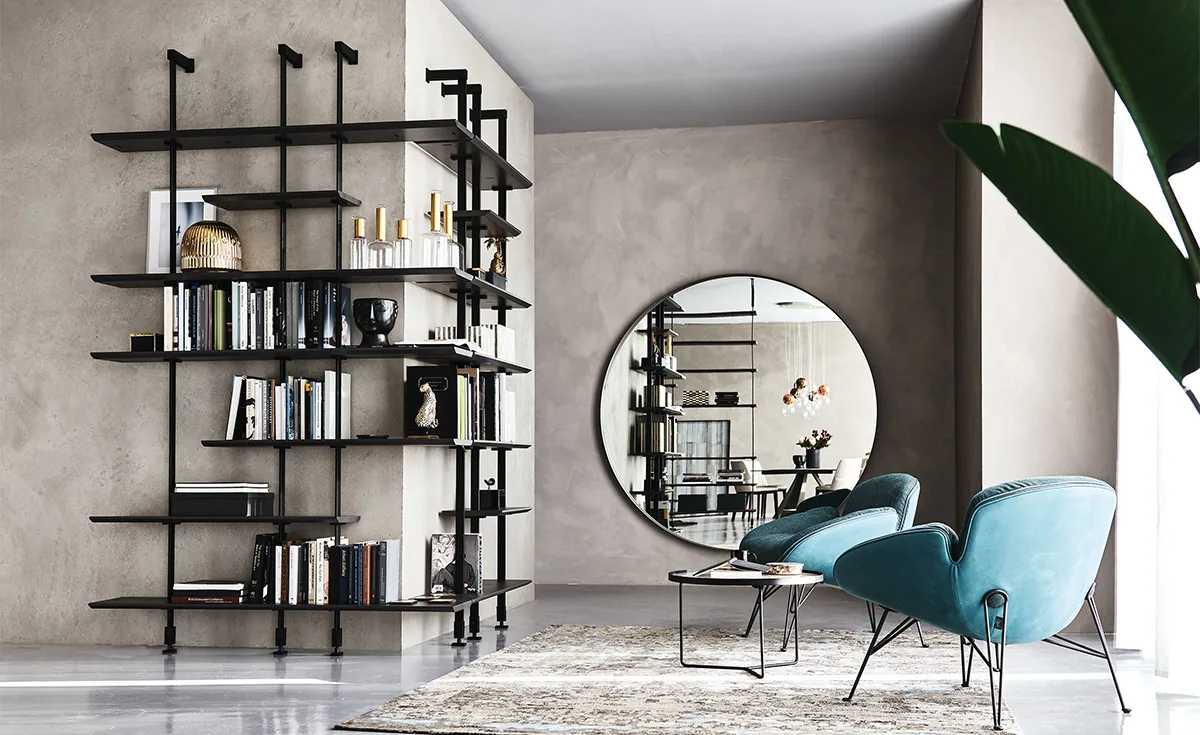
Compare the requirements rather than the labels
| Requirement | Plasterboard: assess | Modular: assess |
|---|---|---|
| Following an irregular wall | Survey, structure and junctions with the room | Available modules and remaining gaps |
| Changing compartment heights | Work needed to alter the construction | Adjustments allowed by the system |
| Storing heavy books | Support design and permitted loads | Specified shelf and fixing capacities |
| Housing equipment | Access, ventilation and maintenance | Cable routes and compatible modules |
| Moving the arrangement | The fixed nature of the construction | Dismantling and suitability for the next room |
The table does not pick a winner. It turns an inspirational image into questions you can put to the designer, installer or furniture supplier.
Shelf depth and the space left in the room
The useful measurement is the compartment’s internal depth. The structure and its thickness add to the external footprint and can leave less room for books than a front-on drawing suggests.
Consider how far the shelving projects into the room and what stands opposite it. If a dining table or armchair is nearby, you need to reach the shelves without interfering with someone using that furniture. Extra depth is not necessarily valuable if it creates hidden rows of books that are difficult to browse.
In a shared living and dining room, establish the routes first using the arrangement of the sofa and dining table. The shelving belongs to the whole room, not only the wall on which it is drawn.
Loads and fixings cannot be judged from a photograph
You cannot determine how much a bookcase can carry from its appearance or finishing material alone. Construction, supports, connections, shelf spans and the building surfaces all matter.
For a plasterboard solution, the professional needs to design the structure for the expected loads. For a furniture system, follow the manufacturer’s load limits and installation instructions, including any required fixings. A substantial-looking structure is not permission to exceed an unconfirmed capacity.
This is a guide to choosing a solution, not to sizing supports or constructing load-bearing elements yourself.
Cost: compare what the complete quotation includes
A price per metre has little meaning without a defined scope. Compositions of the same width can require different work because of their compartment count, junctions, finishes and accessories.
- Surveying and design of the composition.
- The supporting structure and formation of compartments.
- Surface preparation and the specified finish.
- Closed storage elements or additional materials.
- Lighting and electrical work, where included.
- Delivery, installation and arrangements for work inside the home.
For a modular bookcase, compare the complete composition, accessories, installation and delivery terms in the same way. Do not place the price of finished furniture beside that of a structure still needing its finishing stages.
Plan integrated lighting before the shelves are finished
If you want lighting within the compartments, decide what it should illuminate and how components and connections will remain accessible. A light line can emphasise displayed objects, but it should not prevent a component from being replaced or an appliance from being reached.
Electrical design and installation require appropriately qualified professionals. Avoid a composition in which the photographic effect takes priority over the ability to use and maintain the shelving.
Finish the wall without filling every niche
When the shelves already contain plenty of books, a few objects may be enough. Not every compartment needs to become a miniature display arranged in exactly the same way.
For a reading corner, consider a compact armchair and a proportionate side surface. Where shelving shares an open-plan room with dining, think about its relationship with the dining table so the functions remain clear.
The strongest choice responds to the contents, the wall and the years ahead: what it must hold now, how it will be used and how much you want to change later.
Featured image: Airport, Cattelan Italia, a modular bookcase rather than plasterboard shelving, shown to help compare the two approaches. Photo credits: www.arredaremoderno.com.