

Italian designer sideboards: the brands to know and the signature model of each
For years the sideboard was the living room’s back-office piece, the one that held plates and tablecloths. Today it is often the item that gives the room its character, and Italian brands design it like a small piece of architecture.
Italian designer sideboards are recognisable by their fronts: fluting, carving, glass, leather or metal turn a storage unit into a piece you look at before you even open it. We have chosen twelve brands from the Arredare Moderno catalogue and, for each, the sideboard that best tells its story, with the materials and sizes you need to choose well.
At a glance
- The most sculptural: Bonaldo Dorian, Moroso Rows and Capo d’Opera Quadro.
- For a pared-back living room: MDF Italia Minima 3.0 and Gervasoni Daen.
- Glass and mirror at centre stage: Fiam Echo and Tonelli Design Shoji.
- Typical sizes: 40 to 50 cm deep, 70 to 80 cm high, widths from about 130 to over 200 cm.
- Before the model, decide on opening (hinged, sliding, push) and support (floor, legs or wall-hung).
What makes a sideboard a designer piece?
The Italian word for sideboard, madia, originally meant the kitchen chest in which bread was kneaded and stored. Today a sideboard is a long, low storage unit for the living area, with doors and sometimes drawers, used in the living room, dining room or hallway. It becomes a designer piece when the project goes beyond function: a recognisable front, carefully chosen materials, a distinctive way of meeting the floor.
Italian designer sideboard brands to know
Bonaldo
Dorian, designed by Spazioameno, pays tribute to classical architecture with a front of deep vertical flutes that set the surface in motion. The version on blade legs lightens the volume; it comes 138 or 208 cm wide in matt lacquered white, bronze or lead grey.
Moroso
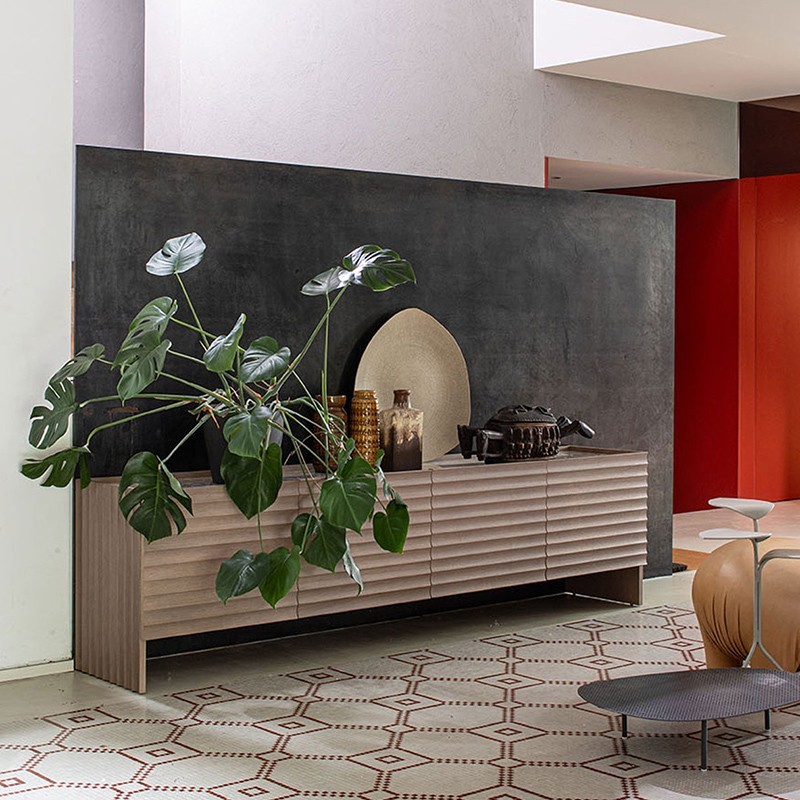
Patricia Urquiola’s Rows plays with horizontal lines and architectural symmetry. The curved grooves in the wood are inspired by the still lifes of the Purist painter Amédée Ozenfant: the milled MDF panels are veneered in oak, with the grain continuing into the grooves.
Cattelan Italia
Tiffany is an elegant living room sideboard: doors upholstered in quilted leather or faux leather, titanium-coloured aluminium profiles, a partly mirrored interior and smoked glass shelves, with optional internal LED lighting.
MDF Italia
Minima 3.0 is a system: an extruded aluminium frame, a top in reconstituted stone or wood and units with flap doors or drawers. It comes in nine sizes and also works in the middle of a room.
Gervasoni
Daen stands on elliptical feet joined by steel bars that match the handles. The doors are covered in a water-repellent, washable fabric, and the top is in porcelain stoneware or back-painted glass.
Capo d’Opera
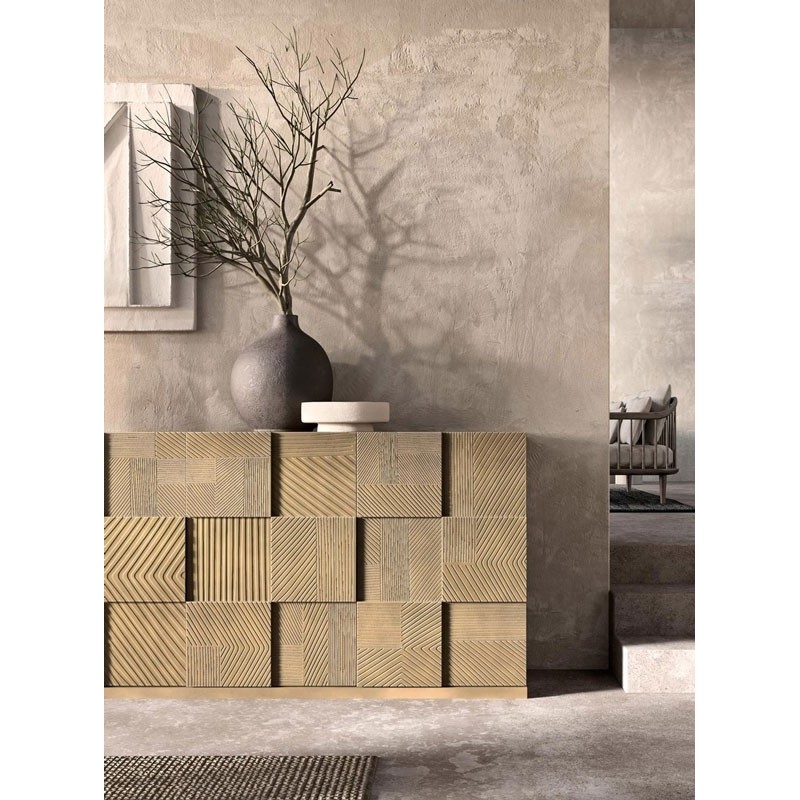
Quadro, designed by Alessio Bassan, has a chequerboard front of squares set at two depths. Each module can be customised with different finishes, wall-hung or on the floor: less a sideboard than a piece of wall art.
Alivar
Bristol has fluted walnut doors, sides and handles in titanium or bronze aluminium, push-to-open doors and a marble or ceramic top. It sits as comfortably in a classic interior as in a contemporary one.
Potocco
Sen takes its cue from Japanese rice paper doors: ash frame and grilles, doors in clear or bronze glass. Light and refined, it suits a hallway or a living room with an oriental feel.
Fiam
Echo, by Marcel Wanders Studio, has 6 mm tempered glass doors, fused or smooth, on a lacquered wood body in white, volcano grey or metallic greige. It measures 134 or 199 cm wide, 47 cm deep and 74 cm high.
Tonelli Design
Shoji is made almost entirely of glass: a smoked glass body, sliding mirrored doors, a fixed base or castors. The top, doors and back are also available in marble-effect ceramic.
Cantori
Mirto combines laser-cut, curved 2.5 mm metal, a solid curved iron base and a bronze smoked mirror top. The welds are hand-polished, and finishes range from mother-of-pearl to patinated bronze.
Colico
Stilt stands on a steel rod base and has slatted MDF doors in pastel colours, from pink to mustard yellow. It is the most playful in our selection, ideal if you want colour without giving up clean lines.
What size should a sideboard be?
Most sideboards are 40 to 50 cm deep and 70 to 80 cm high; low versions drop to around 55 cm, such as Midj’s Lea H55. Widths range from about 130 cm for two doors to over 200 cm for three or four. A practical rule: the sideboard should be shorter than the sofa or table it faces, so it does not visually overwhelm them. If it goes behind a sofa the measurements change, as explained in our guide to the sideboard behind the sofa.
How to choose the right sideboard
Three decisions come before style. Opening: hinged doors are the most practical, sliding doors work where space in front is tight, push-to-open removes handles for a seamless front. Support: legs make the piece lighter and easier to clean under, a plinth gives solidity, wall-hung frees the floor and makes the room feel airier. Top material: marble and ceramic resist heat and scratches, wood is warmer but more delicate.
The sideboard’s style should then be read together with the rest of the living area. To match it with your table, see our guide to the best designer table brands. For a larger solution including TV and shelving, consider modern wall systems. More ideas are in our articles on modern sideboards for the living room and on the sideboard as the star of the living room, while for an overview of brands there is our ranking of the most popular modern furniture brands.
Frequently asked questions
What is the difference between a sideboard and a buffet?
In everyday use they are almost synonyms. A sideboard is usually the long, low unit in the living room; a buffet or credenza tends to belong to the dining room and can be taller or have a hutch.
How deep should a sideboard be?
Between 40 and 50 cm for most models. Below 40 cm dinner plates struggle to fit; above 50 cm the sideboard starts to get in the way.
Wall-hung or floor-standing sideboard?
Wall-hung lightens the room and frees the floor, but needs a load-bearing wall. Floor-standing or on legs is easier to move and supports more weight on top.
Where should a sideboard go in the living room?
Under the TV, against the wall opposite the sofa, behind the sofa if space allows, or in the dining area as a serving surface near the table.
For the history of the sideboard as a piece of furniture, see the sideboard entry on Wikipedia.