

Italian design lamps: the icons, the brands to know and how to choose
You can recognise a design lamp even when it is switched off. The most famous Italian lamps became icons exactly that way: with a shape that stays in your mind before the light it gives.
The most iconic Italian design lamps were born in the 1960s and 1970s: Arco by the Castiglioni brothers for Flos (1962), Pipistrello by Gae Aulenti for Martinelli Luce (1965), Tizio by Richard Sapper for Artemide (1972) and Atollo by Vico Magistretti for Oluce (1977). Alongside the classics, Italian companies keep experimenting with shapes and materials. Here are the historic models, the brands to know today and how to choose the right lamp for each room.
At a glance
- The historic icons: Arco (1962), Pipistrello (1965), Eclisse (1965), Tizio (1972), Cuboluce (1972), Atollo (1977).
- Italian brands to know today: Martinelli Luce, Slamp, KDLN, Cini&Nils, Rotaliana, Italamp.
- For the home, warm light of around 2,700 K works best.
- A colour rendering index (CRI) of 90 or above shows furniture and fabrics in their true colours.
- Above a table, a pendant is usually hung 65 to 80 cm from the top.
What are the most famous Italian design lamps?
The golden age of Italian lighting was the 1960s and 1970s, when designers and manufacturers worked side by side on new shapes and industrial materials. In 1962 Achille and Pier Giacomo Castiglioni designed Arco for Flos, the floor lamp with a marble base and a long curved stem that brings light over the table without a ceiling point. In 1965 Vico Magistretti designed Eclisse for Artemide, whose inner shade rotates to dim the light like the moon in an eclipse.
The same year Gae Aulenti, who two decades later would design the interiors of the Musée d’Orsay in Paris, created Pipistrello for Martinelli Luce: an opal methacrylate shade shaped like outstretched wings on a telescopic steel stem. In 1972 came Richard Sapper’s Tizio for Artemide, a desk lamp with counterbalanced arms and no visible wires, and Cini&Nils’ Cuboluce, a small cube that lights up when you open its lid. In 1977 Magistretti designed Atollo for Oluce, made of three pure geometric forms: cylinder, cone and hemisphere.
Italian design lamp brands to know today
Martinelli Luce
Founded in Lucca by Elio Martinelli, the company looks after two icons from 1965: Gae Aulenti’s Pipistrello, still produced in many versions, and Elio Martinelli’s own Serpente, with a swivelling frame and an opal methacrylate diffuser. For the Musée d’Orsay’s fortieth anniversary, Martinelli Luce dedicated a special edition of Pipistrello to the museum.
Slamp
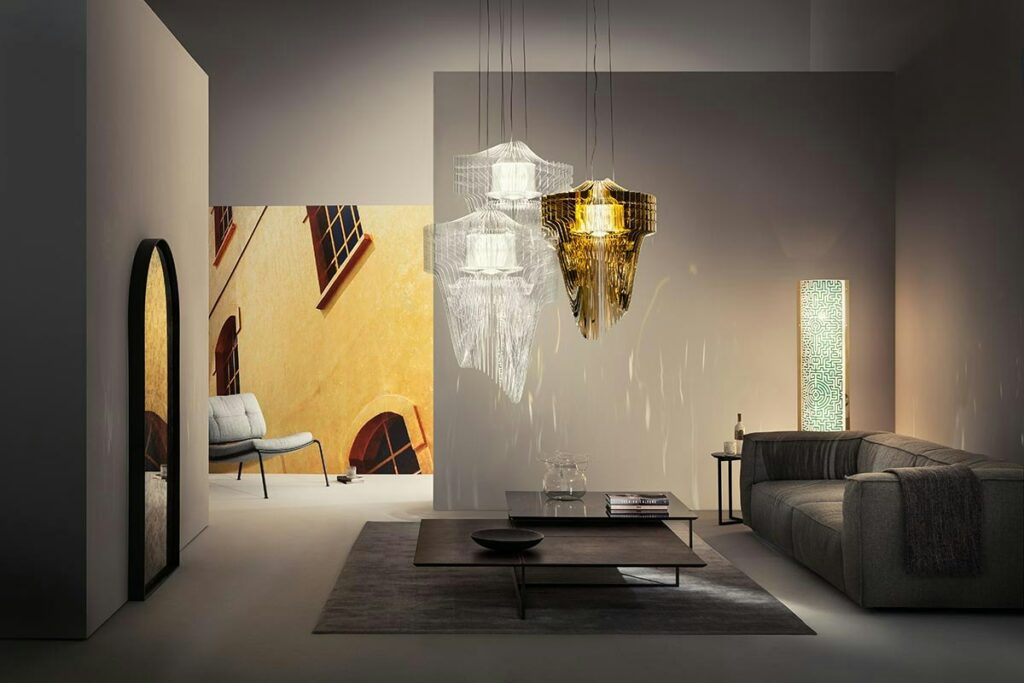
Slamp works with technopolymers such as Lentiflex and Cristalflex, light and flexible materials that capture and diffuse light. The Aria pendant, designed by Zaha Hadid, is made of 50 stacked layers that wrap the LED source in a fluid, three-dimensional volume.
KDLN
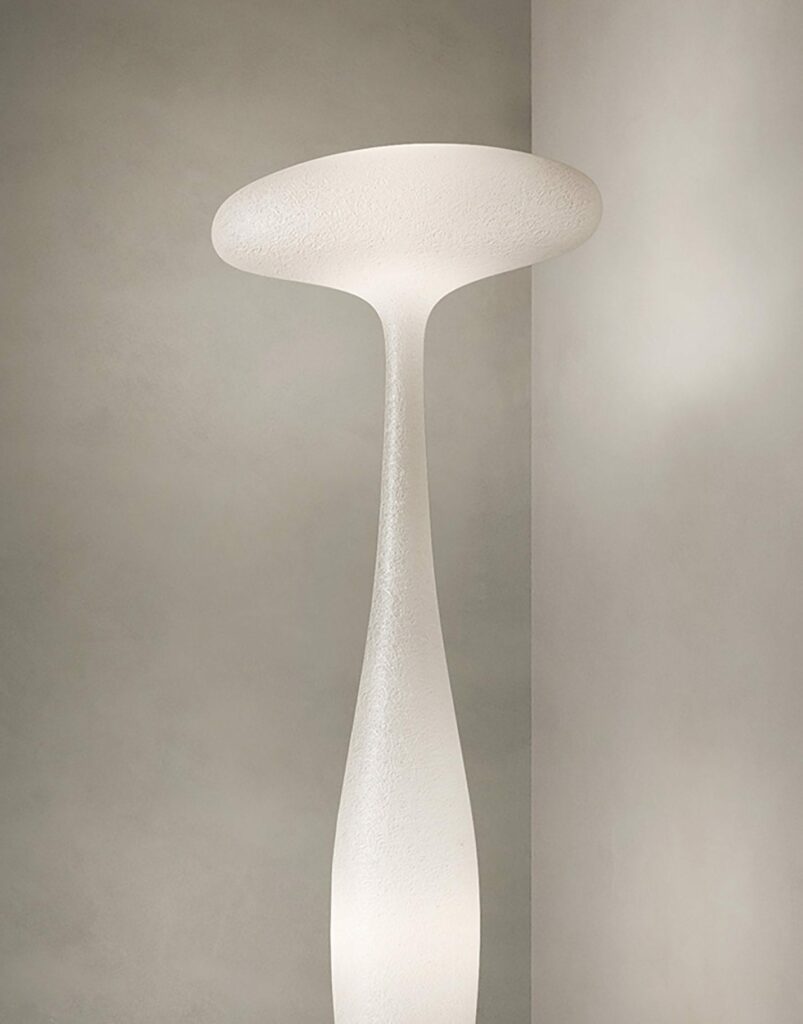
Founded in Milan as Kundalini, the brand is known for organic shapes. E.T.A. by Guglielmo Berchicci is a 200 cm floor lamp in hand-shaped fibreglass that lights up entirely, like an object arrived from another world.
Cini&Nils
Besides the 1972 Cuboluce, now also available in LED and cordless versions with a rechargeable battery, Cini&Nils makes technical pendants such as Fludd, a clear disc with micro-prisms that directs light downwards with high colour rendering.
Rotaliana
Rotaliana designs minimal wall lights such as QB, an aluminium cube that seems set into the wall, with finishes ranging from matt white to antique brass.
Italamp
For lovers of decorative lighting, Italamp’s Opera collection includes pendants such as Airone, gold metal rings on which satin glass leaves rest, with an integrated LED source.
How to choose a design lamp
The first question is where you need light. A pendant lights the table or the centre of the room: over a dining table it is usually hung 65 to 80 cm above the top, and if the table is not centred under the light point there are solutions in our guide to lighting an off-centre dining table. A floor lamp creates ambient or reading light: for its position next to the sofa see our guide to the reading lamp by the sofa. Table and wall lamps complete the scheme with more intimate pools of light.
The second question is the quality of the light. At home a warm colour temperature of around 2,700 K is best, while the CRI, the colour rendering index, tells you how faithfully colours are shown: from 90 upwards, wood, fabric and leather look natural. Finally, dimming matters: a dimmable lamp changes the room from day to evening.
To plan lighting for the whole home, see our article on designing home lighting, with focus pieces on floor lamps, pendant lamps and the TV area. A selection for the living room is in our piece on the most beautiful design lamps for the living room, and the profession behind it all is explained in our guide to lighting design. All the brands mentioned are in the Arredare Moderno catalogue.
Frequently asked questions
Who designed the Pipistrello lamp?
Gae Aulenti, in 1965, for Martinelli Luce, which still makes it today in table and floor versions, including smaller and LED models.
What is the most famous Italian design lamp?
Among the best known worldwide are Arco by Achille and Pier Giacomo Castiglioni for Flos, Pipistrello by Gae Aulenti and Tizio by Richard Sapper for Artemide.
How high should a pendant hang above a dining table?
Usually 65 to 80 cm above the table top: high enough not to block the view between diners, low enough not to dazzle.
What colour temperature is best for home lighting?
Warm light between 2,700 and 3,000 K for living rooms and bedrooms; neutral light around 4,000 K only where you need to concentrate, such as a kitchen or study.
What does CRI mean on a lamp?
It is the colour rendering index, from 0 to 100: it measures how close lit colours look to those seen in daylight. For the home, aim for at least 90.
To learn more about Gae Aulenti, architect and designer, see her entry on Wikipedia.