
Modern fireplace ideas: types, sizes and how to fit one in the living room
Wood, pellet, bioethanol, gas or electric: how to choose the right fireplace for your living room, where to put it, how much space it takes and what to ask the installer before you fall for a photo.
A modern fireplace is almost always a closed one: a firebox with a ceramic glass door that burns wood or pellets far more efficiently than a traditional open hearth, or a flueless bioethanol or electric unit chosen mainly for the look of the flame. The decision starts with the fuel and with whether the house can vent flue gases. The interior design comes next: position, cladding, and how the fire works with the sofa and the media wall.
Below you will find the main types of modern fireplaces, sizes declared by manufacturers, cladding options and safety rules checked against official sources. None of it replaces a site visit from a qualified installer: every house and every chimney is different.
In short
- Modern wood and pellet fireplaces have a closed firebox; MCZ puts their efficiency above 80%, against roughly 15% for a traditional open fireplace.
- Bioethanol and electric fireplaces need no flue; gas, wood and pellet models do.
- In a living room the fireplace can go against a wall, in a corner, double or three-sided, or hanging from the ceiling.
- A wood-burning fireplace about a metre wide can weigh more than 300 kg: check weight and size before planning the furniture.
- In Italy, installing wood and pellet appliances up to 35 kW follows the UNI 10683:2022 standard; elsewhere, national rules apply.
What types of modern fireplace are there?
There are five main types: closed wood-burning, pellet, gas, bioethanol and electric. They differ in fuel, flue requirements and installation work.
Closed wood-burning fireplace (built-in unit or insert)
A modern wood-burning fireplace is either a complete built-in unit with a ceramic glass door or an insert that slots into an existing fireplace opening. MCZ points out that wood has to be loaded by hand several times a day, which is the price of a real flame. Palazzetti uses inserts to replace an old hearth without touching the structure or surround, and full units for new installations.
Pellet fireplace
A pellet fireplace switches itself on and off: an electronically controlled auger feeds the burn pot according to a programmed schedule, as MCZ explains. The shape is more limited: in the MCZ range, pellet fireplaces are front-facing only and go up to about 90 cm wide.
Gas fireplace
It runs on natural gas or LPG and still needs a flue: Kratki’s LEO gas fireplaces have 100/150 mm flue outlets and declared outputs between 4.8 and 16 kW, in front-facing, side-facing or see-through versions, the last of which works as a room divider.
Bioethanol fireplace
It burns ethyl alcohol in a burner and has no flue, so it can go into a flat. Kratki offers wall-mounted, freestanding, corner and surround models, with burners 65, 90 and 120 cm wide. It is a fireplace for atmosphere, with strict refuelling rules covered further down.
Electric fireplace
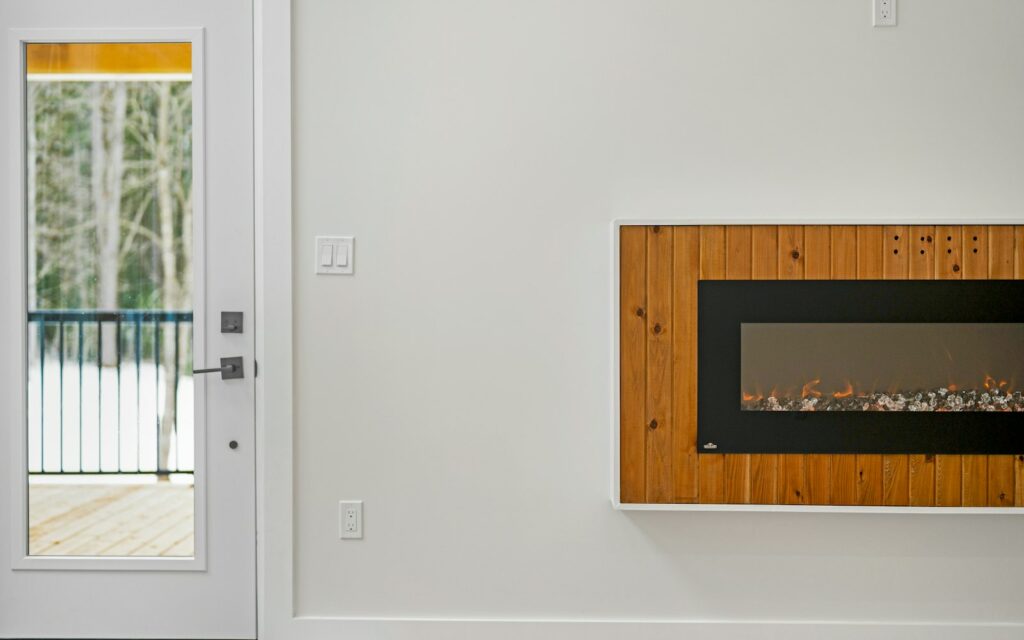
It recreates the flame without burning anything. In Dimplex’s Optimyst technology, ultrasonic vibrations turn water from a tank into a fine mist lit by LEDs; heat, if you want it, comes from a separate 2 kW fan heater. It plugs into a standard socket, and the flame effect works with the heat switched off.
| Type | Flue | Best for |
|---|---|---|
| Closed wood-burning | Yes | A real flame, with room to store logs |
| Pellet | Yes, plus a power socket | Programmable heat |
| Gas | Yes, plus a gas supply | Instant flame and no ash |
| Bioethanol | No | Flats without a chimney, decorative use |
| Electric | No, just a socket | Rented homes, media walls, bedrooms |
Open or closed fireplace: what is the difference?
A closed fireplace heats far better and pollutes far less. MCZ gives a traditional open fireplace an efficiency of up to 15%, against more than 80% for its own modern fireplaces, and estimates that an open fireplace releases around eight times more fine particles than a closed unit. Areas with air quality problems may restrict open fires, so check with your local authority which appliances are allowed before you plan anything.
The glass does not kill the drama: MCZ uses large ceramic glass panels and a refractory lining, Alutec, that turns lighter as it heats up and makes the flame stand out.
Where should a fireplace go in the living room?
The fireplace goes where flue gases can be vented correctly and where you can see it from the sofa. Once the technical spot is fixed, there are four layouts.
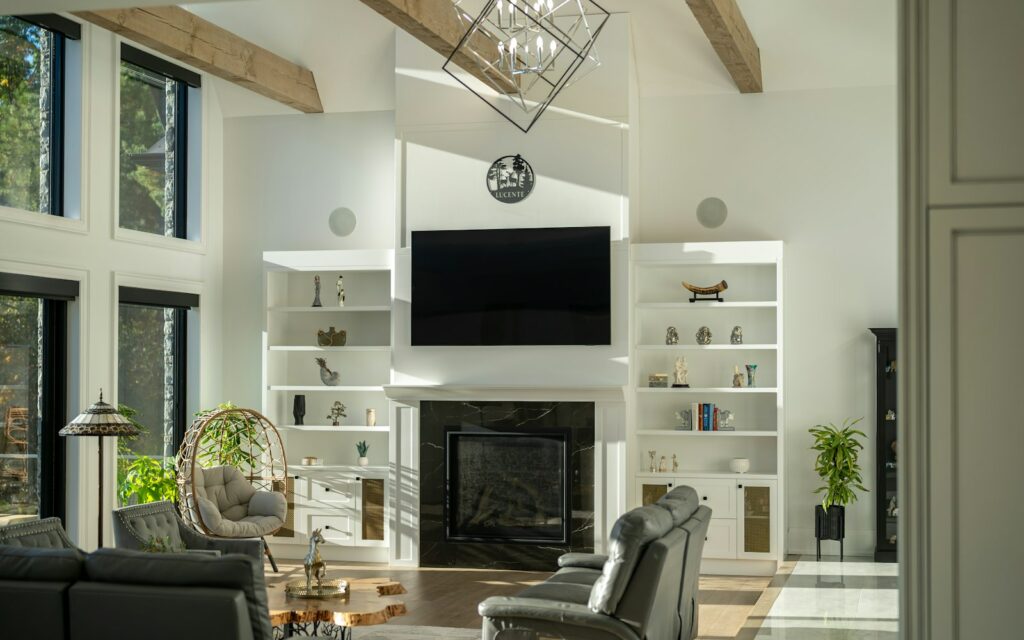
- Against a wall, front-facing: the tidiest option. The fireplace anchors the wall and can sit within shelves and open niches, as in these modern wall systems with shelving and niches, as long as you respect the clearances to combustible materials.
- In a corner: it uses a space that often goes to waste. MCZ makes left and right corner versions of its Plasma line.
- Double or three-sided: the fire is visible from two or three sides, ideal in open-plan spaces between living and dining areas.
- Hanging: the most sculptural choice. Dominique Imbert’s Gyrofocus for Focus is a suspended fireplace that rotates through 360 degrees, 1,250 mm in diameter, available in wood, gas and bioethanol versions.
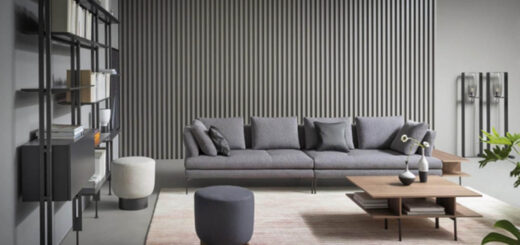
Sofa and armchairs face the fire; the TV should not fight it for the same wall if space is tight. Our guide to furnishing a modern living room shows the most common seating layouts.
How much space does a modern fireplace take?
A wood-burning fireplace with a front of about one metre is just over a metre wide, nearly one and a half metres tall and more than half a metre deep, before you add the surround. These are some sizes declared by manufacturers.
| Model | Type | Declared size and weight |
|---|---|---|
| MCZ Plasma 95 Wood | Wood, front-facing | 105.6 x 141.6 x 53.8 cm; 344 kg (375 kg for the 5S version); 200 mm flue outlet |
| MCZ Plasma B95 Wood | Wood, double-sided | 105.6 x 141.6 x 58.9 cm; 298 kg |
| Focus Gyrofocus | Wood, suspended and rotating | Ø 1,250 mm |
| Kratki Delta, Golf | Bioethanol, wall-mounted or built-in | 65, 90 and 120 cm wide |
Weight is easy to forget: with around 300 kg in a small footprint, a professional must check that the floor can take it. Minimum clearances to beams, timber shelves, curtains and upholstery are set out in each model’s installation manual, and no single figure applies to all of them: ask for them before you design the wall.
Which fireplace surround should you choose?
Choose the surround together with the floor and the wall. Palazzetti lists more than 150 surround designs in stone and marble, including bush-hammered white stone, split slate and quartzite, alongside contemporary materials such as steel, concrete and glass. In a modern living room, three routes work well:
- Large-format stone or porcelain: big surfaces and few joints, so the fireplace becomes part of the architecture.
- Metal: black or burnished steel, slim and graphic, suited to units left on show.
- Smooth plaster: the fireplace disappears into the wall and only the window of flame remains. Materials and insulation for the false wall follow the fireplace manual.
In mountain homes stone is still the natural choice; if that is your case, we have gathered ideas on furnishing a mountain house in Nordic style.
Is a bioethanol fireplace safe?
It is safe if you follow the refuelling rules, because refuelling is when many accidents happen. Australia’s product safety regulator, the ACCC, reports serious burns caused by filling the tank while the flame is still lit, sometimes invisibly, or while the burner is still hot: the ethanol vapour ignites suddenly.
- Refuel only when the flame is out and the burner is cold.
- Use only the fuel the manufacturer recommends and wipe up any spill straight away.
- Light it with the long lighter supplied and put it out with the snuffer tool, never with water.
- Avoid unstable tabletop burners: the ACCC considers them the riskiest.
The Australian standard draws on the stability test of the European standard EN 16647:2015 for these appliances, so ask the seller whether the model complies. The ACCC safety advice on ethanol burners is the clearest guide we found.
What should you ask the installer?
Ask first which rules apply where you live. In Italy, the reference for wood and pellet is UNI 10683:2022 on the UNI website, in force since 4 November 2022: it sets requirements for checking, installing, inspecting and maintaining systems with solid biofuel appliances up to 35 kW, including those built on site or made to measure. In other countries national building rules apply, and a registered installer will know them. In every case, these are the right questions:
- Is the existing chimney suitable, or does it need lining or rebuilding?
- Where does combustion air come from? Some fireplaces, such as MCZ’s Plasma line, can take it from outside through a duct.
- What clearances to combustible materials does the model’s manual require?
- What emissions class does the appliance have, is it allowed in my area, and can the floor carry its weight?
- Who issues the paperwork when the job is done, and how often does it need servicing?
Fireplace or pellet stove?
It depends on how much space you want to give the fire. A fireplace is built into the wall and shapes the room’s architecture; a stove stands on its own and is easier to place. For a broader look at the room around the fire, browse these examples of modern living room furniture.
To picture the living room around the fire, with sofas, coffee tables and wall units, one reference is the Arredare Moderno catalogue, useful for comparing sizes and finishes of living room furniture.
Before you choose: three steps
First check what the house allows: chimney, floor, local rules. Then choose the fuel by how you live in winter: wood for a real flame, pellets for programmed heat, bioethanol or electric for atmosphere without building work. Only then design the wall, with position, surround and furniture around the fireplace.
Sources
- UNI, UNI 10683:2022 standard page (UNI Store).
- ACCC Product Safety Australia, Decorative alcohol fuelled devices or ethanol burners (consumer guide) and Decorative alcohol fuelled devices mandatory standard, updated 17 January 2025.
- MCZ, Modern fireplaces page and Plasma 95 Wood and Plasma B95 Wood product sheets.
- Palazzetti, Wood-burning fireplaces and Surrounds pages.
- Kratki, bioethanol fireplace and gas fireplace catalogues.
- Focus, Gyrofocus product page.
- Dimplex, Optimyst technology page.