
Rug under an extending dining table: size it open or closed?
The rug looks perfectly proportioned under the closed table. Then the extensions come out, the end chairs move back and their rear legs catch the edge. A rug under an extending table should be sized around the table’s real use and the movement of the chairs, not just the closed tabletop.
There is no single answer for every home. A table extended every weekend needs a different compromise from one opened twice a year. Decide which arrangement the room must support most often before comparing rug sizes.
Start with two floor plans
Measure the table closed and fully extended, including any change in the position of the legs. Draw both arrangements with the actual number of chairs. Check whether the extension is symmetrical or moves the tabletop further in one direction.
Then place the other furniture on the plan. A rug that accommodates the largest setting may reach a doorway or a sideboard. The guide to arranging the sofa and dining table helps you judge that footprint in the whole room.
Measure the chair when someone stands up
Do not take the chair’s tucked-in position as the reference. Sit at the table, move back to stand up and note where all four feet land. Repeat with the deepest chair and at the ends of the extended table.
The objective is to avoid a chair repeatedly rocking across the rug edge during normal movement. The required margin depends on chair depth, leg position and how people get up. It is a measurement to make, not a fixed allowance to copy unquestioningly.
A worked example with explicit assumptions
Imagine a table measuring 160 × 90 cm closed and 240 × 90 cm open. Suppose your chair test indicates a 75 cm margin on each side. In this hypothetical case, the closed layout requires 310 × 240 cm; the open layout requires 390 × 240 cm.
The calculation is simple: table length plus two margins, and table width plus two margins. The 75 cm here is an assumed result of a test, not a universal recommendation. It does not describe the pictured rug. If the table extends off-centre, calculate the available space at each end separately.
What if neither result matches a standard rug size?
Compare available sizes with the larger footprint you actually need, rather than rounding down because a smaller rug looks tidier. Check manufacturing tolerances and the stated dimensions before ordering. A few centimetres can matter when a chair leg is already close to the edge.
For a review of the table itself, use our guide to dining table sizes and seating capacity. Adding guests changes more than the tabletop: chairs and circulation need to be included too.
When the extended table is used only occasionally
A very large rug may overwhelm the normal layout. You could plan the room for the frequent arrangement and remove the rug for occasional larger gatherings, provided doing so is practical. Another option is to use no rug under the dining table.
What is less useful is treating chairs half on and half off the edge as an acceptable permanent compromise. Try the full movement before deciding that the difference will not matter. A rug is optional; a stable, usable dining arrangement is not.
Think about the surface, not just the dimensions
Check how the actual chair moves over the pile and whether its feet catch. A low-profile surface can be easier to assess for chair movement, but construction and fibre vary: follow the rug and chair manufacturers’ guidance.
Food, cleaning and the floor underneath also matter. Select an appropriate underlay if required and check compatibility with the flooring and any underfloor heating. Do not assume that every backing or anti-slip layer is suitable for every surface.
Test the outline before choosing the colour
Mark the proposed rug boundary using removable tape suitable for the floor. Open the table, place every chair and sit in the end positions. Walk towards the kitchen while others remain seated. Once both layouts work, choose texture and colour. The best size is the one that stays out of the way when dinner becomes a longer conversation.
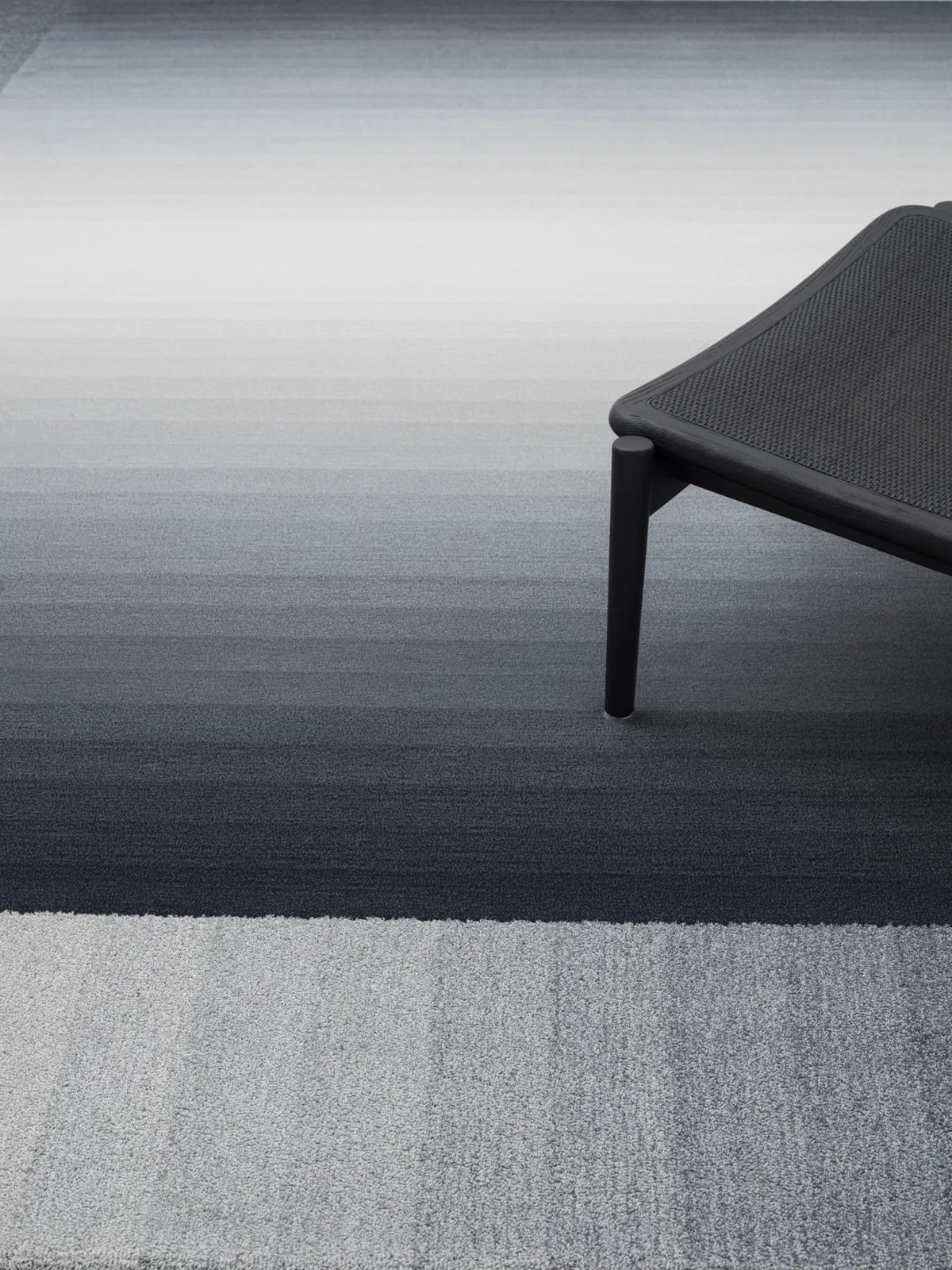
Featured image: Grade rug, Désirée. Photo credit: www.arredaremoderno.com.