


TV viewing distance: chart by screen size and how to arrange the sofa
How far should the sofa be from the TV? It depends on screen size, resolution and how immersed you want to feel. Here is an updated chart, how TV inches are measured and how to arrange the living room around them.
The right TV viewing distance comes from the screen diagonal: multiply it by about 1.2 for the minimum immersive distance, which gives a 40-degree viewing angle, or by about 1.6 for a more relaxed distance with a 30-degree angle. For a 55-inch TV, a 140 cm diagonal, the useful distance between sofa and screen therefore runs from roughly 1.7 to 2.3 metres.
The sofa and the TV nearly always share a room, and whenever you buy one or the other the same questions come up: how far apart they should be, how big the TV should be, how big the sofa, and how much space the living room has. This guide answers them with checked figures.
In short
- Minimum immersive distance: diagonal × 1.2 (about 3 cm per inch). This is Samsung’s rule and matches the THX 40-degree recommendation.
- More relaxed recommended distance: diagonal × 1.63 (about 4.1 cm per inch), a 30-degree angle.
- With a 4K set you can sit closer than with Full HD before the pixels show.
- TV inches measure the screen diagonal, and one inch is 2.54 cm.
- The centre of the screen should sit at the eye level of a seated viewer.
How do you work out the best distance between sofa and TV?
Multiply the screen diagonal by a factor that depends on the viewing angle you want. The two most widely used rules are these.
- The 40-degree rule (immersive viewing): according to Samsung’s TV size buying guide, you multiply the screen size by 1.2, because the screen should take up 40 degrees of your field of view. THX gives the same angle for the best seat.
- The 30-degree rule (relaxed viewing): this is the field of view associated with SMPTE guidance and equals about 1.63 times the diagonal on a 16:9 screen. It is the most comfortable distance for news, series and long sports sessions.
The sweet spot sits between the two: closer to 40 degrees for films and gaming, closer to 30 degrees for everyday viewing. Once the angle drops below about 28 degrees, which THX gives as the limit for the maximum distance, the picture loses its pull.
How are TV inches measured?
A TV’s size in inches is the length of the screen diagonal, from the bottom left corner to the top right. One inch is exactly 25.4 mm, or 2.54 cm, so to convert inches to centimetres you multiply by 2.54. A 55-inch TV has a diagonal of about 140 cm, a 65-inch about 165 cm.
Width and height matter when you choose a TV unit or wall system. On a 16:9 screen the width is about 87% of the diagonal and the height about 49%: a 55-inch panel is roughly 122 cm wide and 68 cm high, plus the bezel listed in the spec sheet.
TV viewing distance chart
Knowing how many inches your TV measures is enough for a reliable calculation. For each size, the chart shows the minimum immersive distance, the more relaxed recommended distance and the distance from which the eye can no longer pick out individual pixels in Full HD and in 4K.
| Screen size | Diagonal | Minimum immersive distance (40°) | Recommended distance (30°) | Full HD: pixels disappear from | 4K: pixels disappear from |
|---|---|---|---|---|---|
| 32-inch | 81 cm | 0.98 m | 1.32 m | 1.28 m | 0.64 m |
| 40-inch | 102 cm | 1.22 m | 1.65 m | 1.59 m | 0.80 m |
| 43-inch | 109 cm | 1.31 m | 1.78 m | 1.71 m | 0.86 m |
| 50-inch | 127 cm | 1.52 m | 2.07 m | 1.99 m | 1.00 m |
| 55-inch | 140 cm | 1.68 m | 2.27 m | 2.19 m | 1.10 m |
| 65-inch | 165 cm | 1.98 m | 2.69 m | 2.59 m | 1.30 m |
| 75-inch | 190 cm | 2.29 m | 3.10 m | 2.99 m | 1.49 m |
| 85-inch | 216 cm | 2.59 m | 3.51 m | 3.39 m | 1.69 m |
The last two columns are based on the optimal viewing distance described in Recommendation ITU-R BT.500, expressed in picture heights: 3.2 times the height for Full HD and 1.6 times for 4K. The bigger the TV, the greater the distances, so the deeper the living room needs to be.
4K or Full HD: does the distance change?
Yes, resolution changes the minimum distance, not the maximum. With Full HD, sitting very close makes the pixel grid visible; a 4K panel has four times as many pixels, so the same picture stays sharp at half the distance. In practice, 4K lets you choose a bigger screen for the same sofa position. For very large screens, Samsung strongly recommends a high resolution such as 4K to avoid a blurry picture.
How high should the TV be?
The centre of the screen should be at the eye level of someone sitting on the sofa. Low-slung modern sofas put the eyes lower too, so measure your real seated eye height before fixing the bracket. A TV mounted too high, above a fireplace for instance, forces you to tilt your head back and strains the neck.
Which TV for your sofa?
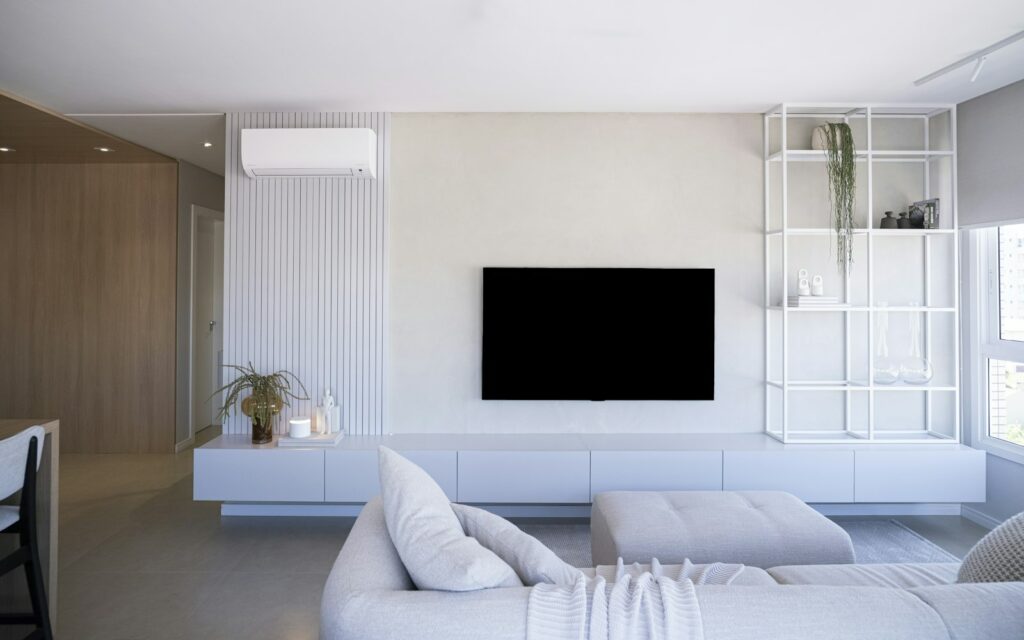
Start from the space you have and decide what matters most: if the TV comes first, it will shape the choice of sofa; if the sofa comes first, its depth and position will limit the screen size. Applying the chart, some typical combinations are:
- 2-seater sofa in a compact living room: a 40- or 43-inch TV at about 1.3 to 1.8 metres;
- 3-seater sofa: a 50- or 55-inch TV at about 1.5 to 2.3 metres;
- corner or chaise sofa in an open-plan space: a 65- to 75-inch TV at about 2 to 3 metres.
To work out the space you need, add the depth of the sofa and of the TV unit to the viewing distance. For real seat depths, see our guide to sofa seat depth and usable measurements. If you like to stretch out, chaise sofas and recliners with footrests add seats and comfort.
What if there is not enough space for the right distance?
Architectural constraints such as pillars, doors or windows often stop you placing the sofa at the ideal distance, and they also dictate whether the TV goes on the wall or on a stand. An extending, tilting wall bracket helps here: it lets you bring the screen forward or push it back and correct its angle. Otherwise, choose a TV a few inches smaller: at a short distance, a 50-inch 4K set is more pleasant than a 65-inch screen that is too close.
How do you plan a modern living room around the sofa and TV?
Placing the sofa and TV means working around free walls, doors, windows and balconies. A few practical rules:
- Avoid glare: do not put the TV facing a window or with a window behind the sofa; side light is the easiest to manage. If the question is the sofa, read whether it is better to place the sofa under or in front of the window.
- Do not watch TV in the dark: soft light around the TV area reduces the contrast between screen and room. Ideas in our guide on how to light the TV area.
- Line up sofa and screen: the middle seat should face the centre of the screen, with the side seats within a comfortable angle.
- Build the TV into the furniture: a modern wall system hides cables and devices and keeps the screen at the right height.
To pick a sofa that suits your living room and your viewing distance, one reference is the Arredare Moderno catalogue: before ordering, compare the model’s measurements with the distance worked out here.
Frequently asked questions
How far should you sit from a 65-inch TV?
For a 65-inch TV, about 165 cm diagonal, the distance runs from about 2 metres for immersive viewing to about 2.7 metres for relaxed viewing.
What is the minimum distance for a 50-inch TV?
For a 50-inch TV the minimum immersive distance is about 1.5 metres; the more comfortable recommended distance is about 2.1 metres.
Sources
- Samsung UK, What size TV should I get: screen size × 1.2 and a 40-degree field of view.
- Wikipedia, Optimum HDTV viewing distance: SMPTE 30 degrees (about 1.63 times the diagonal), THX 40 degrees, ITU-R BT.500 (3.2 H for Full HD, 1.6 H for 4K).
- Wikipedia, Inch: 25.4 mm.