


Who invented the mattress? From straw to memory foam
Before the bed there was bedding: a layer of grass and leaves laid on the ground. The story of the mattress starts there and ends with pocket springs, latex and a foam first designed for aircraft seats.
Who invented the mattress? No single person did. The mattress grew out of a long series of steps rather than one invention. The oldest known constructed bedding is around 77,000 years old and was found at Sibudu in South Africa, while the modern milestones have clear names and dates: James Marshall’s pocket spring patent (1900 to 1901), the latex foam developed at Dunlop in 1929 and the “memory” foam created in 1966 under a NASA programme for aircraft seating.
This piece follows the mattress only, the part you actually sleep on. The frame underneath, from the floor mat to the four-poster, has its own history, which we cover in a separate article.
In short
- The oldest well-documented bedding comes from Sibudu, South Africa, about 77,000 years ago: sedges, rushes and aromatic Cryptocarya woodii leaves that kept insects away.
- Roman mattresses were stuffed with reeds, hay or wool; feathers arrived as a luxury towards the end of the Republic.
- The word “mattress” comes from the Arabic matrah, “something thrown down”, and reached Europe through Sicily.
- Coil springs went into mattresses in the 1820s; James Marshall patented the pocket spring in 1900 to 1901.
- Latex foam: Dunlop, 1929, sold as Dunlopillo. Memory foam: NASA programme, 1966.
What is the oldest mattress in the world?
The oldest constructed bedding described in detail comes from the Sibudu rock shelter in South Africa and dates to about 77,000 years ago. A team led by archaeologist Lyn Wadley of the University of the Witwatersrand published the find in Science in December 2011. The bedding consists of compacted layers less than an inch thick, roughly three feet by six, made of grasses and sedges.
What stands out is the choice of plants. On top of the base layer lay stems and leaves of Cryptocarya woodii, a Cape laurel whose aromatic leaves contain compounds that kill mosquitoes. Even then, bedding was about hygiene as well as comfort, as Smithsonian Magazine reported. In 2020 the same research group described even older grass bedding, from around 200,000 years ago, at Border Cave, also in South Africa.
What did the Egyptians and Romans sleep on?
In ancient Egypt, those who could afford it slept on raised bedsteads with bolsters and pillows, and mattresses were already a traded good. A papyrus from 257 BC, part of the Zenon archive held in Cairo, mentions a man waiting in Jaffa for a chance to export goods that included mattresses.
Roman sources tell us more. Roman mattresses were stuffed with reeds, hay or wool, and towards the end of the Republic, as taste for luxury grew, feather fillings appeared. In the Greek and Roman world the mattress rested on a frame of stretched straps, a principle that lives on, far more refined, in today’s slatted bed bases.
Where does the word “mattress” come from?
It comes from the Arabic al-matrah, the large cushion or rug for lying on, literally “the thing thrown down”. The word entered medieval Latin as matracium in Sicily, then Italian as materasso, which gave Old French materas in the 12th century and Middle English materas around 1300. The commonly accepted account is that mattresses spread into Europe partly through the court of Frederick II in Sicily, during the period of the Crusades.
What were mattresses like in the Middle Ages?
A medieval mattress was a cloth sack filled with whatever was at hand: feathers, wool or hair for the wealthy, straw for everyone else. By the 14th century feather beds were highly prized possessions, while poorer households slept on mattresses of dried heather or fern. In the 15th century mattresses were often filled with pea shucks, straw or feathers.
In much of Europe, ordinary people slept on sacks of seaweed, reeds, straw or chaff until the modern era. A stuffed and stitched mattress was a luxury for the few; only in the late 19th century did saddler-made mattresses, often in three sections, become common in middle-class homes.
Who invented the spring mattress?
Coil springs were first fitted into mattresses in the 1820s, according to Encyclopaedia Britannica, and they transformed bed comfort. Bonnell coils, the classic interlinked springs, were adapted from 19th-century carriage seat springs. So the first spring mattress was not the work of one inventor either.
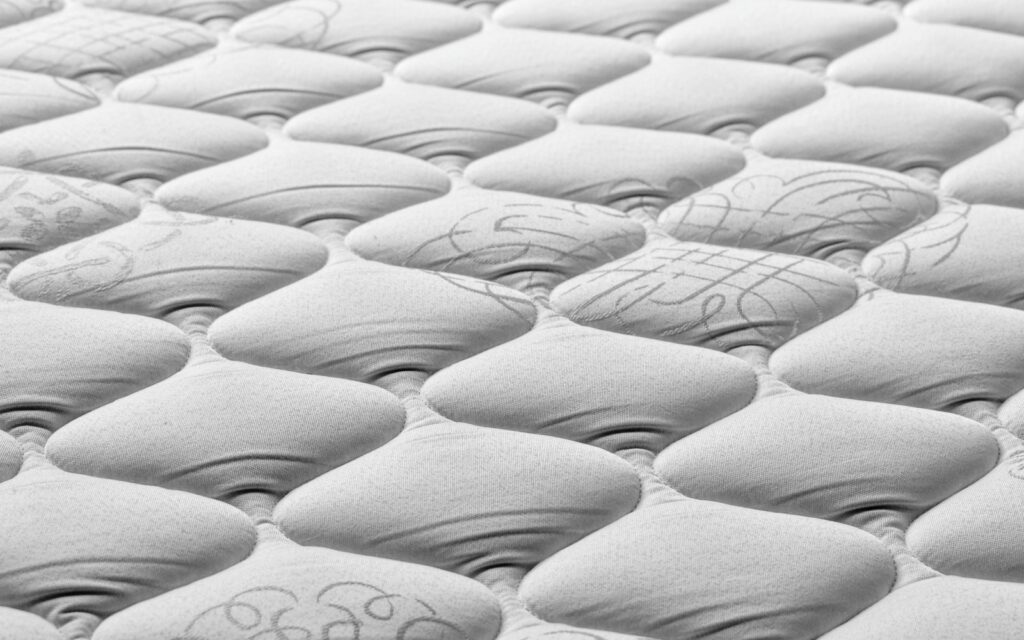
The decisive step belongs to James Marshall of Toronto, Canada. His US patent no. 685,160, filed on 1 September 1900 and granted on 22 October 1901, describes a mattress made of many coil springs, each enclosed in its own fabric pocket. The stated aims were to keep the springs in place, stop them rubbing and squeaking, and make a mattress that was light, ventilated and easy to disinfect. It is the pocket spring principle still found in many mattresses today.
When was the latex mattress invented?
Latex foam was born in 1929 in Dunlop’s laboratories in Birmingham, where chemists Edward Arthur Murphy and Eric Owen produced a sponge rubber by whipping latex into a froth. It was marketed as Dunlopillo and first used for seating in trams, trains and cockpits; Murphy is also credited with the first latex mattress, in 1931. Dunlop’s US patent on the production method was published in 1933. After the Second World War, latex and polyurethane foam became the dominant fillings.
Was memory foam really invented by NASA? A short history
Yes, in the sense that it came out of a NASA programme, though not for mattresses. According to NASA Spinoff, the foam was developed in 1966 to absorb shock and make aircraft seats more comfortable and safer. Aeronautical engineer Charles Yost, contracted through Stencel Aero Engineering Corporation, created an open-cell polymer foam with viscoelastic properties, and the team at Ames Research Center built it into a new seat design. It was first called “slow spring back foam”.
In 1969 Yost founded Dynamic Systems to sell the technology as “temper foam”, and in 1974 the company sold the rights. The two qualities the engineers wanted, energy absorption and an even spread of body weight and pressure, are the same ones that took the foam first into medical use and then into home mattresses.
Mattress history at a glance
| When | Where | What |
|---|---|---|
| About 200,000 years ago | Border Cave, South Africa | Grass bedding |
| About 77,000 years ago | Sibudu, South Africa | Layers of sedge and grass with insect-repelling Cryptocarya woodii leaves |
| 257 BC | Ptolemaic Egypt | A Zenon archive papyrus mentions mattresses for export |
| Roman era | Rome | Reed, hay or wool fillings; feathers from the late Republic |
| 12th century | Sicily, France | Arabic matrah becomes Italian materasso and French materas |
| 14th to 15th century | Europe | Feather beds for the rich; heather, fern, straw and pea shucks for others |
| 1820s | Europe | First coil springs in mattresses |
| 1900 to 1901 | Toronto, Canada | James Marshall patents the pocket spring |
| 1929 | Birmingham, UK | Dunlop produces latex foam (Dunlopillo) |
| 1931 | UK | First latex mattress, credited to E. A. Murphy |
| 1966 | United States | Viscoelastic foam developed for aircraft seats under a NASA programme |
| 1960s | The West | Air mattresses and water beds catch on |
What does this history tell us when choosing a mattress today?
It tells us that the three main families answer old and different needs. Marshall’s pocket springs were designed to keep every spring independent, quiet and well ventilated. Latex brings the elasticity of rubber to the bed. Memory foam was engineered to absorb energy and spread body pressure. Before buying, ask which of these qualities matters most to the person sleeping on it, and try the mattress on the base it will be used with, because frame and filling work together, just as they did on Roman straps.
Covers matter too: to choose protectors, bases and pillows, see our guide to mattress covers, bed bases and pillows. For the frame itself, from early bedding to the modern bed, read our history of the bed from prehistory to today, and if you are looking for the right model for your bedroom, start with our pick of Italian designer bed brands. A useful reference is the Arredare Moderno catalogue, handy for comparing beds and bedroom furniture.
Sources
- Smithsonian Magazine, “The World’s Oldest Mattress” (E. Wayman, 14 December 2011), on Wadley et al., Science 334 (2011)
- Wadley et al., “Fire and grass-bedding construction 200 thousand years ago at Border Cave, South Africa”, Science (2020), cited in Wikipedia, “Sibudu Cave”
- NASA Spinoff 2005, entry on Charles Yost’s temper foam (spinoff.nasa.gov)
- Google Patents, US 685,160 “Mattress”, James Marshall (1901)
- Google Patents, US 1,929,603 “Manufacture of Rubber Goods”, Dunlop Rubber Co. (1933)
- Encyclopaedia Britannica, “Bed”
- Online Etymology Dictionary, “mattress”
- Wikipedia, “Bed”, “Mattress”, “Matratze” (German), “Foam rubber”, “Edward A. Murphy (chemist)”