


How to decorate a Christmas tree: colour schemes, lights and decorations
Lights, garlands, baubles and a topper: a tree looks its best when each layer goes on at the right moment and the colours speak to the rest of the room. Here is the order to follow, how many lights each height needs and colour schemes for every style, white trees included.
The secret of how to decorate a Christmas tree is to work in a set order: lights first, wound from the base up to the top, then garlands and ribbons, then baubles from the largest to the smallest, and the topper last of all. Before you start, choose a palette of two or three colours that suits your interior and work out how many lights you need: around 100 lights for every foot of height gives a balanced look.
For many people Christmas is the best time of the year, when homes, streets and shops dress up for the season, and the tree is still the best-loved decoration of all. Trends change every year: some people update their tree to follow them, others bring out the same ornaments decade after decade, some want it modern, some traditional, covered in lights or dusted with snow. The method below works with every style.
In short
- The right order: lights, garlands and ribbons, large baubles, small baubles and hanging ornaments, topper.
- Lights: about 100 per foot of height for a balanced look, twice that for a showpiece tree.
- Colour scheme: two or three colours at most, taken from the colours and materials of your living room.
- White tree: coloured or metallic decorations stand out better than white ones.
- Safety: lights bearing the CE marking, no overloaded sockets, lights unplugged overnight and when you go out.
Where do you start when decorating a Christmas tree?
Start with the lights, because they need to go deep into the branches before anything else. A tree without lights is a little like a lighthouse with the lamp switched off: it needs the right lights, spread evenly. Some artificial trees come pre-lit, but most need stringing by hand, and that is the most demanding part of the job, especially on a tall tree.
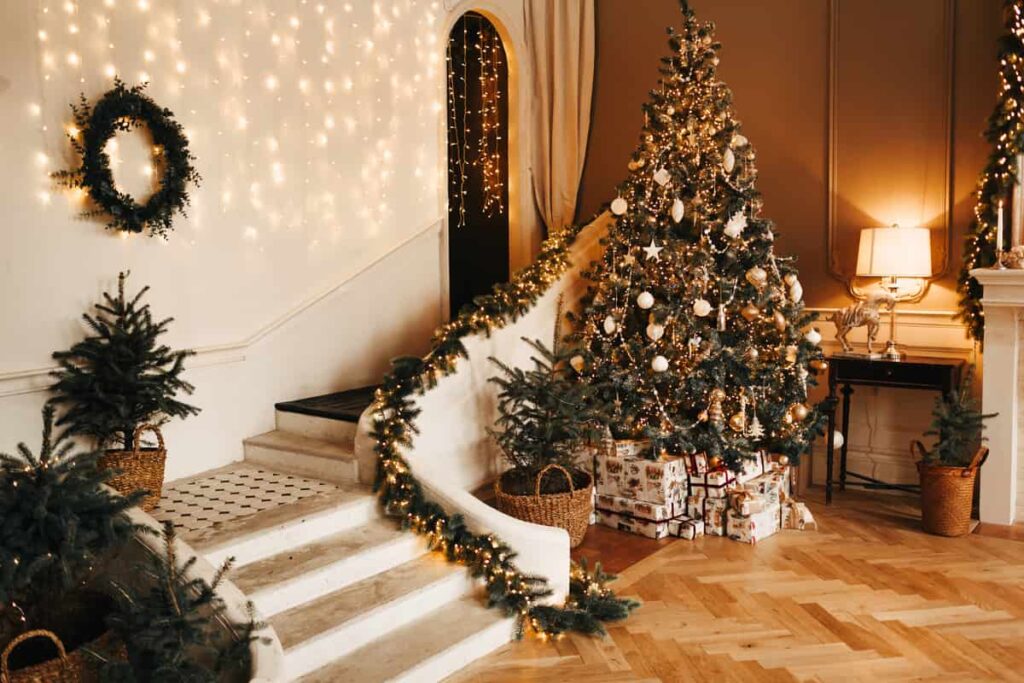
The full order, step by step:
- Prepare the tree: on an artificial tree, open out and shape every branch; for a real tree, choose a stand with a water reservoir.
- Lights: start at the base and work upwards, weaving the strands in and out of the branches. Step back now and then to check for gaps.
- Garlands and ribbons: drape them in a spiral or let them fall vertically, from top to bottom.
- Large baubles: hang them first, some deep inside the branches, to build volume.
- Small baubles and hanging ornaments: fill the remaining gaps, keeping the most fragile pieces high up, away from children and pets.
- Topper: it finishes the tree and always goes on last.
How many lights does a Christmas tree need?
A practical rule from Balsam Hill, a maker of artificial trees, is about 100 lights per foot of height for a balanced look, and double that for a more dramatic display. Trees over 2 metres therefore need several strings of lights.
| Tree height | Lights for a balanced look | Lights for a showpiece look |
|---|---|---|
| 6 ft (about 180 cm) | 600 | 1,200 |
| 7 ft (about 210 cm) | 700 | 1,400 |
| 8 ft (about 240 cm) | 800 | 1,600 |
| 9 ft (about 270 cm) | 900 | 1,800 |
LEDs are the sensible choice today. According to the US Department of Energy, residential LEDs use at least 75% less energy and last up to 25 times longer than incandescent bulbs; as Christmas lights they also run much cooler, which lowers the risk of burns, and they are far more resistant to breakage.
Warm white or cool white lights?
The colour temperature depends on your interior style and the mood you want. Warm white lights feel cosy and welcoming and suit any style, especially a traditional one. Cool white lights fit a modern, pared-back interior and emphasise clean lines. If your living room lamps already give a warm light, stay with the same temperature: two different whites in one room stand out. To choose lamps that work alongside the tree, browse our selection of Italian design lamps.
Which colours work best for Christmas tree decorations?
Stick to two or three colours, taken from the living room: the colour of the sofa, the fabrics and the woods will suggest the most coherent palette. A single colour is the easiest way to a clean, polished tree; if you love variety, add a few new pieces each year within the same range.
| Interior style | Colour scheme | Decoration materials |
|---|---|---|
| Scandinavian | White, natural wood, sage green | Wood, felt, wool, paper |
| Modern minimal | White, black, silver | Glass, metal, matt ceramic |
| Traditional | Red, gold, deep green | Velvet, blown glass, satin ribbon |
| Warm and natural | Taupe, copper, terracotta | Jute, copper, pine cones, dried citrus |
Handmade ornaments have their place too: polystyrene balls covered in fabric, twine or wool, bows and little figures made at home if you enjoy crafts. Recent trends favour full, almost lavish trees, sometimes with soft toys and elves peeping out from the branches: the choice is personal, as long as the palette holds it all together. For ideas for the rest of the house, see our guide to decorating your home for Christmas.
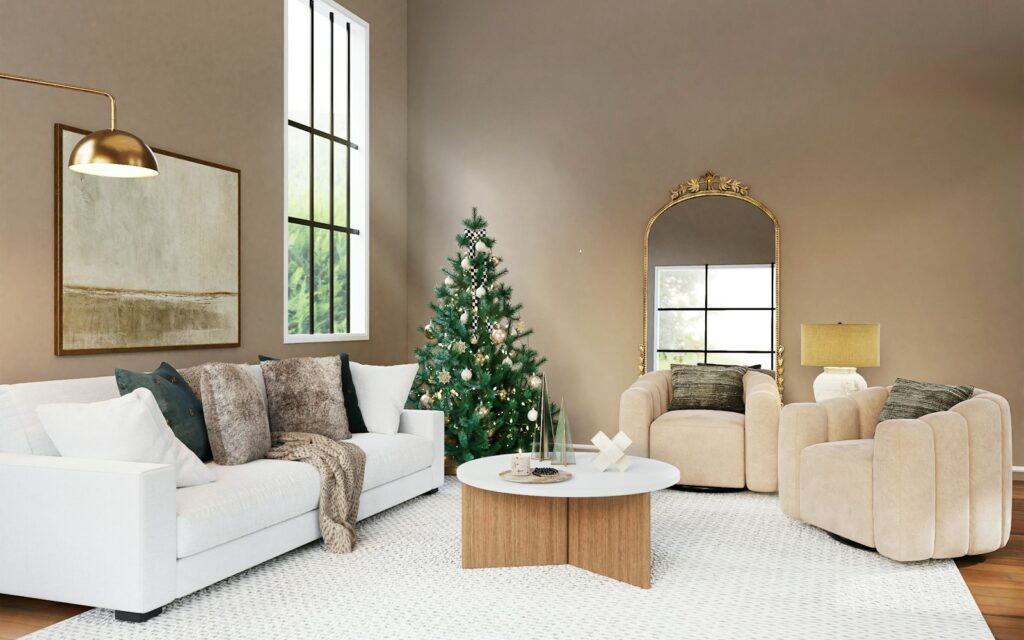
How do you decorate a white Christmas tree?
A white or flocked tree shows off coloured and metallic decorations, which stand out more against a pale background than on a green tree. Gold and copper give a warm effect, silver and pale blue a wintry one, or you can pick one strong colour such as red or bottle green. All-white decorations, on the other hand, tend to disappear on a white tree. Warm white lights keep it from looking too cold in the evening.
What should go on top of the tree?
The topper completes all the other decorations, yet it is often overlooked. Many people choose a classic spike, but almost anything can go at the top: a star, a bow, a Christmas character, bought or handmade. What matters is that it shows off the top of the tree, is a little larger than the other decorations and sits firmly on the tip, because its job is to draw the eye upwards.
How do you decorate a tree in a small space?
In a small living room, a slim tree with a narrow footprint works best, or a tabletop tree on a console or sideboard. A few tips:
- place it in a corner, out of the way of walkways and doors that open towards it;
- choose small, light decorations that do not weigh down the silhouette;
- use a single colour for a tidier overall look;
- keep it away from radiators and other heat sources, which dry out real trees.
To arrange the rest of your ornaments without crowding the room, read how to decorate your home with ornaments.
How do you use Christmas tree lights safely?
Christmas lights are electrical appliances and should be treated as such. The essentials:
- buy lights bearing the CE marking, with which the manufacturer indicates that the product meets EU product rules, and check that cables and plugs are undamaged;
- the charity Electrical Safety First advises unplugging Christmas lights when you are out and overnight, and not overloading sockets and extension leads;
- keep a real tree well watered: the same charity points out that it can drink up to a litre of water a day, and that a dry tree can catch fire much faster than a fire-retardant artificial one.
Where does the Christmas tree tradition come from?
Among the earliest documented references is a chronicle from Bremen, dated 1570, describing a tree decorated with apples, nuts, dates and paper flowers. The custom spread across Europe during the nineteenth century, and in Britain it caught on after Prince Albert brought it to the royal residences. The first electric lights on a tree are credited to Edward H. Johnson, an associate of Thomas Edison, in New York in the 1880s.
For cushions, throws and lamps in the same palette as your tree, one reference is the Arredare Moderno catalogue.
Once the tree is finished, the next step is the festive table: you will find ideas in our guide to laying the Christmas table.
Sources
- Balsam Hill, How Many Lights Do I Need for My Christmas Tree?: 100 lights per foot, chart from 6 to 9 ft, lights from the base upwards.
- U.S. Department of Energy, LED Lighting: energy use, lifespan and benefits of LED holiday lights.
- Electrical Safety First, Christmas tips: unplug lights overnight, avoid overloading sockets, water real trees.
- Your Europe, CE marking.
- Wikipedia, Christmas tree (Bremen chronicle of 1570, Prince Albert, Edward H. Johnson).